Copy trading on prediction markets: does it work?
Copy trading on prediction markets can work, but most copiers lose to luck, bad fills and size mismatch. How to pick traders and set limits that hold up.
By Preddy Team
Short answer: sometimes. Some traders on prediction markets have a real, repeatable edge, and every one of their trades is public. But copying them is a different trade from the one they made. You enter later, at a worse price, at a different size, and often without knowing why they bought. Most of the gap between "this trader is up big" and "I'm up copying them" comes from those differences.
Here's how it works, where it breaks, and how to pick a trader and set limits so that when it breaks, it breaks small.
How does copy trading work on prediction markets like Polymarket?
Polymarket runs on a public blockchain, so every wallet's trades are visible: what it bought, at what price, how much, and when it sold. A copy trading tool watches a wallet you choose and, when that wallet trades, places a matching order from your account.
"Matching" doesn't mean identical. You decide how big each copied trade is: a fixed dollar amount, a percentage of what the trader spent, or the same share of your budget as their trade was of their portfolio. You also decide whether to copy their sells, and what to skip.
Why copy trading can work
Prediction markets reward specialists. A trader who follows one sport closely, models weather data, or reads election polling better than the crowd can be right more often than prices imply, and do it for years. Unlike a fund manager's marketing deck, their record is on-chain and can't be edited after the fact.
That's the honest case for it: real skill exists, and you can see it.
Why copy trading often doesn't work
Leaderboards are full of luck
Imagine 1,000 traders who each make 10 coin-flip bets. On average, about one of them wins all ten (1 in 1,024), and around 55 win eight or more. None has any skill, but sort by profit and they're at the top looking like geniuses.
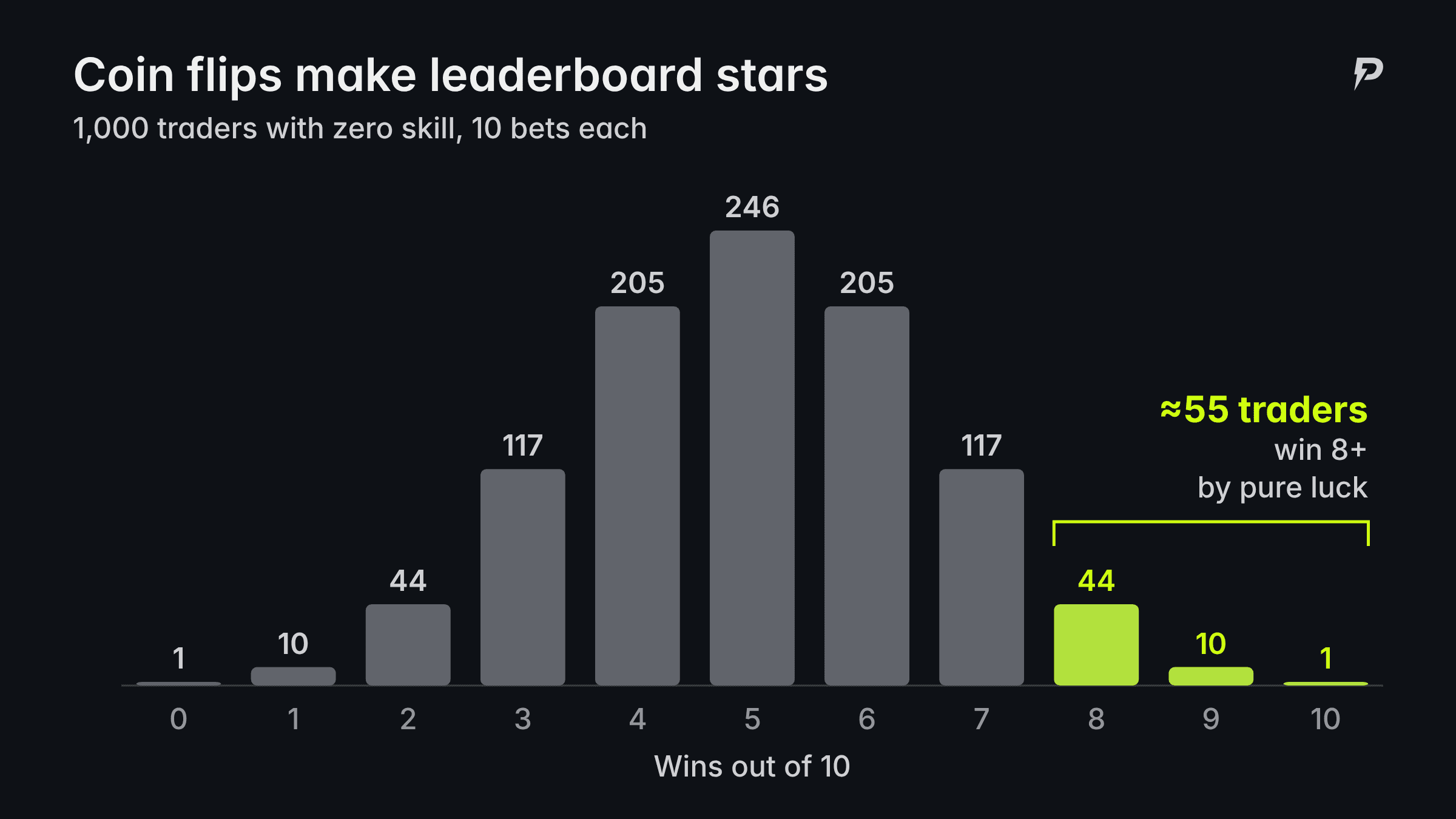
Real leaderboards work the same way. The more traders there are, the more impressive the luckiest ones look. And you only see the survivors: the ones who blew up last month aren't on the list.
One big win can make a whole track record
A wallet up $200,000 might have made $250,000 on one election and lost $50,000 on everything else. That's a great call, not a strategy you can copy forward. Before you follow anyone, mentally delete their single best trade and look at what's left.
You buy after them, at a worse price
The trader buys first. Your order follows. By then their own buying may have moved the price, and other copiers are buying too.
A hypothetical example: the trader buys Yes at 30¢ and believes the real chance is 35%. Their edge is 5¢ per share, about 17% on what they paid. Your copy fills at 33¢, and Preddy's 0.5% fee brings your cost to about 33.2¢. Your edge is now 1.8¢ per share, around 5.5%. Same trade, same thesis, roughly a third of the expected profit. If your fill is 35¢, you have no edge at all.
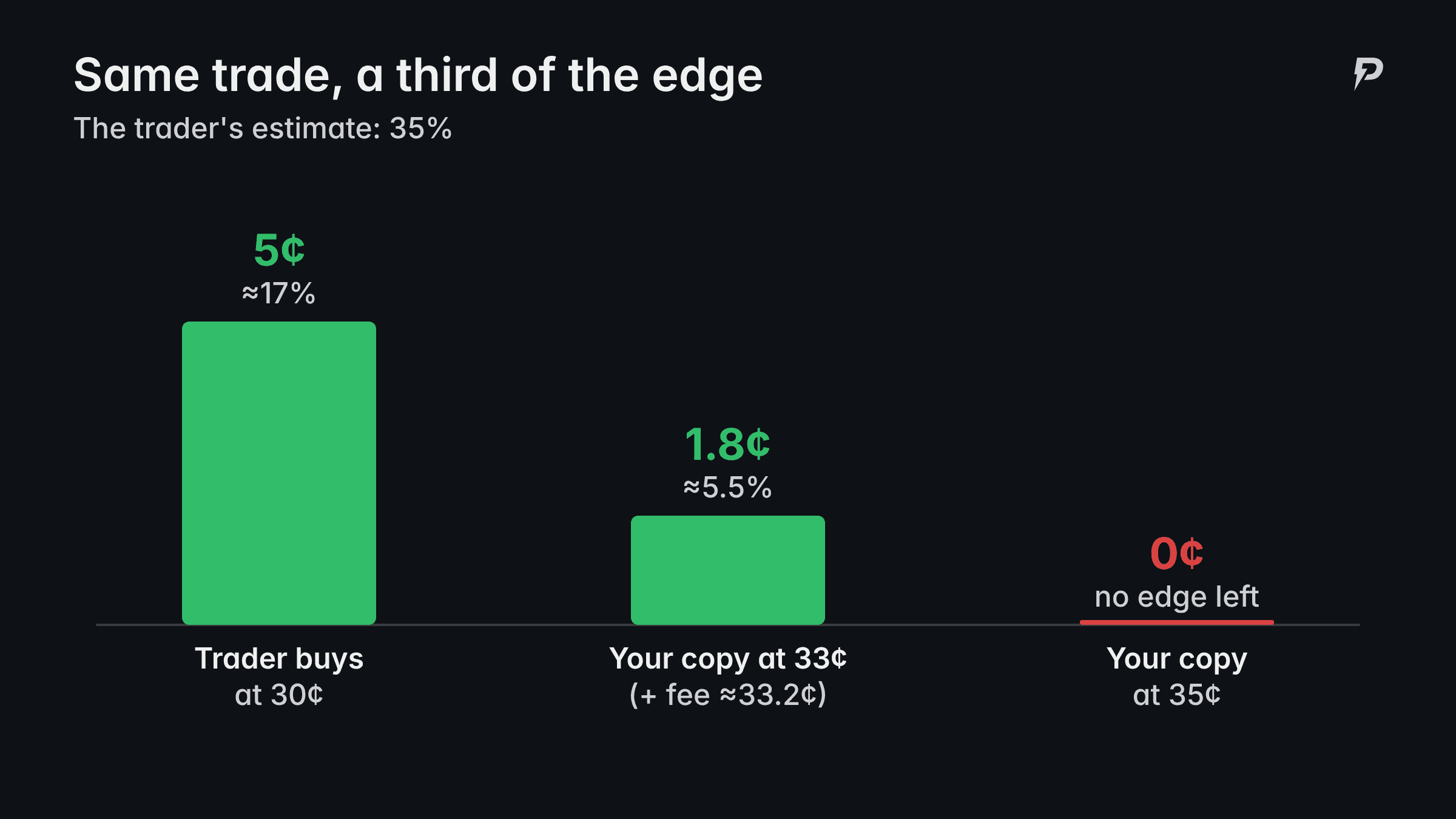
The smaller the trader's edge, the more this matters. Copying someone who buys at 90¢ expecting 93% leaves almost nothing after a 2¢ worse fill.
You don't see the whole position
A wallet is not always a whole strategy. The trader may hold the opposite side in another wallet, hedge on a different platform, or be a market maker who buys and sells all day to earn the spread. Copying one leg of a hedge, or a market maker's individual fills, gives you exposure they don't actually have.
Whales move thin markets
A $20,000 buy in a market with a few thousand dollars per price level walks the book up several cents. You copy into the price they just pushed, and it can drift back once they stop buying. Big traders in small markets are the hardest to copy.
Size doesn't scale down cleanly
Say the trader has a $1,000,000 portfolio and you have a $500 budget. They put $10,000 (1%) into a market. A portfolio-weighted copy puts $5 of yours in, which is fine. Then they trim 10% of the position, selling $1,000. Your matching sell is 50¢, below Polymarket's $1 minimum order, so it can't be placed. Small budgets miss small exits, and over time your positions drift away from theirs.
Fees add up on active traders
Preddy charges 0.5% on each copied buy and each copied sell. A trader who enters and exits before resolution costs you about 1% per round trip, plus whatever you lose to worse fills. On a trader who scalps a couple of cents at a time, that can be the whole edge. The fee is a flat percentage, so on its own it doesn't hit small trades harder. What hurts small budgets is the $1 minimum from the previous section: the smallest copies are the ones that get skipped.
How to pick a trader worth copying
- Enough history. Dozens of resolved markets at minimum. Ten wins in a row is a story; two hundred trades with a steady profit is evidence.
- Profit without the best trade. If removing one market turns them negative, skip them.
- Consistency across timeframes. On the Top Traders page you can switch between daily, weekly, monthly and all-time results. A trader who's good over all of them is more convincing than one with a single hot month.
- Win rate in context. A 95% win rate can mean zero skill. Buy 20 markets at 95¢ and win 19: you make 5¢ a share nineteen times (95¢) and lose 95¢ on the one miss. Net: zero. Look at PnL and ROI next to win rate, and at the prices they usually buy at.
- Categories they're good in. Many traders are sharp in one area and average elsewhere. If their wins come from sports, copy only their sports trades.
- Position size vs. liquidity. If their typical trade is bigger than the books they trade in, you'll always fill worse than they did.
- How they exit. Traders who hold to resolution are easier to copy than traders who trade in and out, because there are fewer sells to mirror and fewer fees.
- Drawdowns. Look at their worst stretch. If you'd have quit during it, you'll quit when it happens to you, usually at the bottom.
The Top Traders page lets you sort by PnL, win rate, ROI, volume and number of predictions, and filter by behaviour (for example Whale, Market Maker or Buy & Hold). Treat the ranking as a shortlist, then open the profile and check the points above. Watching a wallet with alerts for a week or two before copying costs nothing and tells you a lot.
How to set up copy trading sensibly on Preddy
Each risk above has a matching setting in Preddy's strategy builder. The settings guide covers all of them; these are the ones that matter most.
| Risk | Setting | What to do |
|---|---|---|
| Losing more than you planned | Budget: Total budget, Daily budget | Set both before anything else. Total budget caps lifetime spend; sells return budget. |
| A bad streak | Auto-pause on drawdown | Pauses the strategy when realized PnL falls a set amount (in dollars or % of budget) from its peak. |
| One oversized trade | Buy Size: Fixed $, or % of trader / Portfolio-weighted with a max buy size | Start with a small fixed amount, or cap the percentage modes with a max. |
| Size mismatch on exits | Sell Size: % of position | Sells the same fraction of your position as they sold of theirs, so it never tries to sell more than you hold. |
| Bad fills | Advanced → Price Protection: Max buy / sell price move | New strategies start at 10¢. On a 30¢ entry that's a third worse than their price, so consider tightening it. |
| Long shots or near-certainties | Advanced → Triggers: Entry price min / max | E.g. copy only buys between 20¢ and 80¢. |
| Their test trades and tiny buys | Advanced → Triggers: Trader buy trigger min | Ignore buys below a dollar amount. |
| Categories they're bad at | Advanced → Market Scope: categories, min volume, min liquidity | Include only the categories where they're strong; skip thin markets. |
| Too much in one place | Advanced → Exposure: max per market, max per outcome, max open markets | Keeps one market from dominating the strategy. |
Two defaults to know about. Fast copy mode is on for new strategies: it reacts to the trader's orders before on-chain confirmation, which is faster but can occasionally copy a trade that never confirms. And under Execution Rules, the default is to skip a trade if it can't fill in full, rather than take a partial fill.
Copytrading needs offline signing, an opt-in permission restricted to trading actions.
A cautious starting setup (example)
A hypothetical first strategy for a $300 test:
- Total budget $300, daily budget $50, auto-pause on drawdown at 25% of budget.
- Buy size: Fixed $10.
- Sell size: % of position, 100%.
- Max buy price move: 3¢. Entry price: 15¢ to 85¢.
- Market scope: only the trader's strongest category, with a minimum liquidity.
Then let it run for 20 to 30 copied trades and compare your fills with the trader's in the strategy log. If you're consistently several cents behind, or many copies are skipped, adjust before adding money. If the results are poor after a fair sample, stop. That's the strategy working as a test.
So, does copy trading work?
It works best when you copy a trader with a long, broad record, in markets deep enough that your order doesn't move the price, with a budget you've sized as if the trader could be wrong. It works worst when you copy last week's leaderboard winner, at full size, in thin markets, with loose price limits.
Copying doesn't remove risk. It swaps "am I right?" for "is this person right, and can I get close to their price?" Size it like any other bet; position sizing and risk covers how. And if fills are where your edge leaks out, market vs limit orders explains why.
When you're ready, start with the Copy Trading overview, then the settings guide.