Market vs limit orders on prediction markets
Market vs limit orders on prediction markets: how the orderbook works, what the spread and slippage cost you, and which order type to use when.
By Preddy Team
The price on a market card is not the price you'll get. What you actually pay depends on the orderbook behind it and the type of order you send. In a deep market the difference is a fraction of a cent. In a thin one, a careless market order can cost you more than your edge.
This post shows how the book works, how to calculate what a market order really costs, and when a limit order is the better tool.
How does a prediction market orderbook work?
Every outcome has an orderbook: a list of people waiting to buy (bids) and people waiting to sell (asks), each at a price and a size in shares. Here's a hypothetical book for YES in one market:
| Side | Price | Shares |
|---|---|---|
| Ask | 47¢ | 3,000 |
| Ask | 45¢ | 1,500 |
| Ask | 44¢ | 800 |
| Ask | 43¢ (best ask) | 400 |
| Bid | 41¢ (best bid) | 600 |
| Bid | 40¢ | 1,200 |
| Bid | 38¢ | 2,500 |
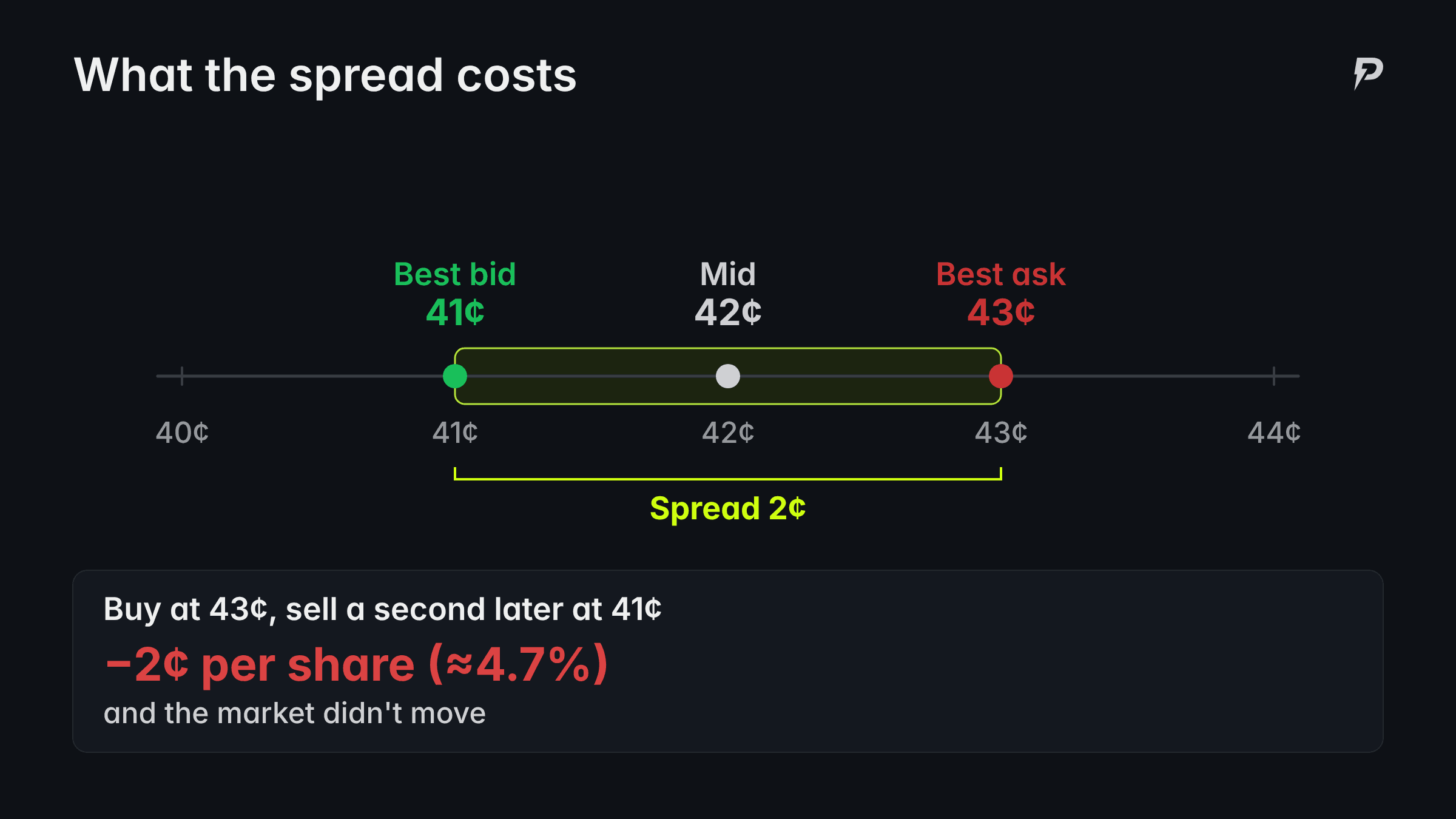
The best ask (43¢) is the cheapest you can buy right now. The best bid (41¢) is the most you can sell for right now. The mid price is halfway between, 42¢, and it's often the number a market card shows as the "probability".
Depth is how many shares sit at each level. This book has only 400 shares at the best ask. Anything bigger has to buy from higher levels.
On Polymarket, which is where Preddy routes your orders, the YES and NO books are mirrors of each other. A bid for NO at 57¢ appears as an ask for YES at 43¢, because one YES plus one NO always adds up to $1. More on that in how to read prediction market prices.
What is the spread, and what does it cost you?
The spread is the gap between the best bid and the best ask: 43¢ − 41¢ = 2¢ here.
It's the price of trading in a hurry. Buy at 43¢ and change your mind a second later, and the best you can sell at is 41¢. You've lost 2¢ per share, about 4.7% of what you paid, without the market moving at all.
A tight spread (1¢) usually means an active, liquid market. A spread of 5¢ or more means few people are quoting it, and you should be careful with anything but a limit order.
Market orders and slippage: a worked example
A market order says "fill me now at whatever the book offers". It takes the best ask first, then the next level, and so on until your order is filled. This is called walking the book.
Say you send a market order for 2,000 YES shares into the book above:
| Level | Shares filled | Cost |
|---|---|---|
| 43¢ | 400 | $172.00 |
| 44¢ | 800 | $352.00 |
| 45¢ | 800 (of 1,500) | $360.00 |
| Total | 2,000 | $884.00 |
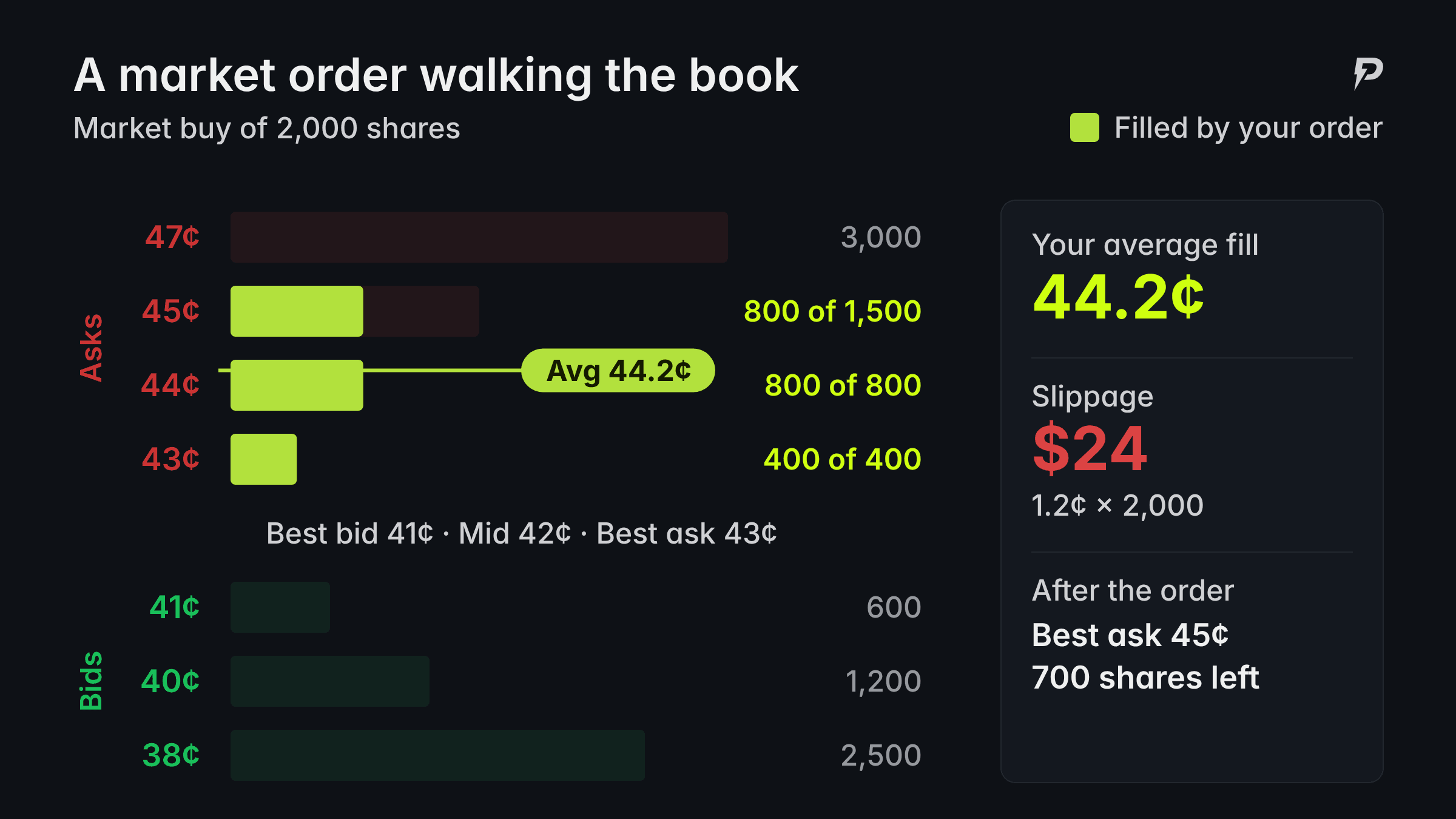
Your average price is $884 / 2,000 = 44.2¢: not the 43¢ best ask, and not the 42¢ mid.
- Slippage against the best ask: 1.2¢ per share, $24 across the order.
- Against the mid: 2.2¢ per share, $44.
- On Preddy, market orders carry a 0.5% fee: $4.42 on $884.
- After your order, the best ask is now 45¢, with 700 shares left.
To make money on this trade, YES now has to be worth more than about 44.4¢ to you, not 42¢. If your edge was 2 or 3 cents, you just spent most of it getting in.
Preddy's betslip shows the Avg. Price before you confirm. Check it every time. It's the number you're actually paying.
How do limit orders work?
A limit order says "buy (or sell) at this price or better, and no worse". If it can fill right away at your price, it does. Whatever can't fill rests in the book until someone trades against it or you cancel it.
Same book. Instead of a market order, you place a limit buy for 2,000 shares at 42¢:
- Nobody is selling at 42¢, so nothing fills yet.
- Your order becomes the new best bid. The spread narrows to 1¢ (42¢ / 43¢).
- When a seller decides to sell at the market, they hit your 42¢ before the 41¢ bid.
If it all fills, you pay $840 instead of $884 plus the fee. That's $48.42 saved on one trade. The catch: it might never fill, and you have no say over when it does.
A limit order can also act as a capped market order
A limit price above the best ask fills immediately, like a market order, but it stops at your limit. Place a limit buy for 2,000 at 44¢ into the original book:
- 400 fill at 43¢ and 800 fill at 44¢: 1,200 shares for $524.
- The other 800 rest at 44¢ and become the new best bid.
You get most of the size now and never pay more than 44¢. For buying into a moving market, this is often better than a plain market order.
Partial fills
Orders don't have to fill all at once. Back to your 42¢ bid for 2,000: a seller sells 700 at the market. You now hold 700 shares (cost $294), and 1,300 are still resting at 42¢.
You can leave the rest, change the price, or cancel it. Partially filled orders are easy to forget, so check your open orders when you're done trading for the day.
Maker vs taker: what's the difference?
- A taker removes liquidity from the book: market orders, and limit orders that fill right away.
- A maker adds liquidity: a limit order that rests in the book until someone else fills it.
Takers pay the spread and get certainty. Makers earn the spread (they buy at the bid or sell at the ask) and give up certainty.
On Preddy the fee follows the order type. Market orders cost 0.5%; limit orders are free. So are split and merge. Copytrade and stop-loss executions carry the 0.5%. The full table is in fees. Some markets also carry their own fees, so check before you trade.
Market or limit order: which should you use?
The short answer: it's a trade-off between urgency and price.
| Situation | Better choice | Why |
|---|---|---|
| Breaking news, the price is about to move | Market, or a limit above the ask | Being filled now matters more than 1–2¢ |
| Small order in a deep market, tight spread | Either | Slippage is tiny |
| Thin market or wide spread | Limit | A market order could fill far from the mid |
| Big order relative to depth | Limit, ideally laddered | Walking the book gets expensive fast |
| No rush, you have a target price | Limit | You set the price, and it's free on Preddy |
| Exiting a position you've decided to cut | Market, or a stop loss | Getting out matters more than the last cent |
If you know in advance where you'd want out, a stop loss sells for you when the price gets there, so you don't have to be watching.
Practical tips
Check depth before size. Before a big order, look at how many shares sit within 1–2¢ of the best price. If your order is bigger than that, a market order will walk the book. The Pro orderbook shows a running total of size from the best price, so you can read how much fills up to each level.
Don't market-buy illiquid markets. If a market has a 6¢ spread and a few hundred shares on each side, a market order is a donation to whoever's quoting. Use a limit.
Improve the price inside the spread. If the bid is 41¢ and the ask is 45¢, you don't have to choose between them. A bid at 43¢ goes to the front of the queue and often fills when the next seller arrives, cheaper than the 45¢ ask.
Ladder big orders. Instead of one bid for 2,000 shares, split it: 700 at 42¢, 700 at 41¢, 600 at 40¢. If all three fill, you pay $821, an average of 41.05¢. If only the top one fills, you still got a position at a good price.
Watch your resting orders around news. A resting bid gets filled exactly when sellers rush in, which is often when bad news has just landed. If you have orders sitting in a market that's about to have a big moment (a game kicking off, a vote count, a court ruling), decide beforehand whether you still want them filled.
Mind the tick size. Most markets trade in 1¢ steps, some in 0.1¢. Near 1¢ or 99¢, a single tick is a big relative move, so the spread matters more there.
Read Avg. Price, not the card. The card shows a headline price. The betslip shows what you'll actually pay.
A quick rule of thumb: if your order is small next to the size at the best price, use whatever's convenient. If it isn't, use limit orders.
Quick recap
- Bids are buyers, asks are sellers, and the spread is the gap between them.
- A market order fills now, walks the book, and pays the spread plus slippage. Preddy charges 0.5% on it.
- A limit order fills at your price or better, can rest in the book, and is free on Preddy, but it might not fill.
- A limit above the ask is a market order with a price cap.
- Check depth, use limits in thin markets, and ladder big orders.
Want to see it in practice? Open any market, look at the book, and compare the Avg. Price for a small and a large order before you trade.
Keep reading
How to read prediction market prices
Prices as probability, odds conversion and expected value.
Position sizing and risk
How much to put on a trade, and how stop losses fit in.
How to trade Polymarket with Preddy
A step-by-step guide to your first trade.
Prediction market glossary
Bid, ask, spread, depth and every other term explained.