Position sizing and risk management for prediction markets
How much to bet on each prediction market trade. Kelly criterion for binary shares with worked examples, the 95¢ trap, stop losses, and a checklist.
By Preddy Team
Most people spend all their energy on picks: is this price too low, will this happen. Far fewer think about how much to put on each trade. That second question decides whether a good trader ends the year up or broke.
This guide covers how to size positions in prediction markets, how the Kelly criterion works for binary shares, and the risk mistakes that cost people the most.
Why position sizing matters more than your picks
A hypothetical. You start with $1,000. You find 100 trades where you buy at 50¢ and the outcome really happens 60% of the time. That's a real edge: each share costs 50¢ and is worth 60¢ on average.
Say you win exactly 60 and lose 40 (the order doesn't change the result). Same picks, same win rate. The only thing that changes is how much of your current bankroll you put on each trade:
| Stake per trade | Bankroll after 100 trades |
|---|---|
| 100% | $0 (gone at the first loss) |
| 50% | $33 |
| 40% | $783 |
| 20% | $7,490 |
| 10% | $4,501 |
| 5% | $2,401 |
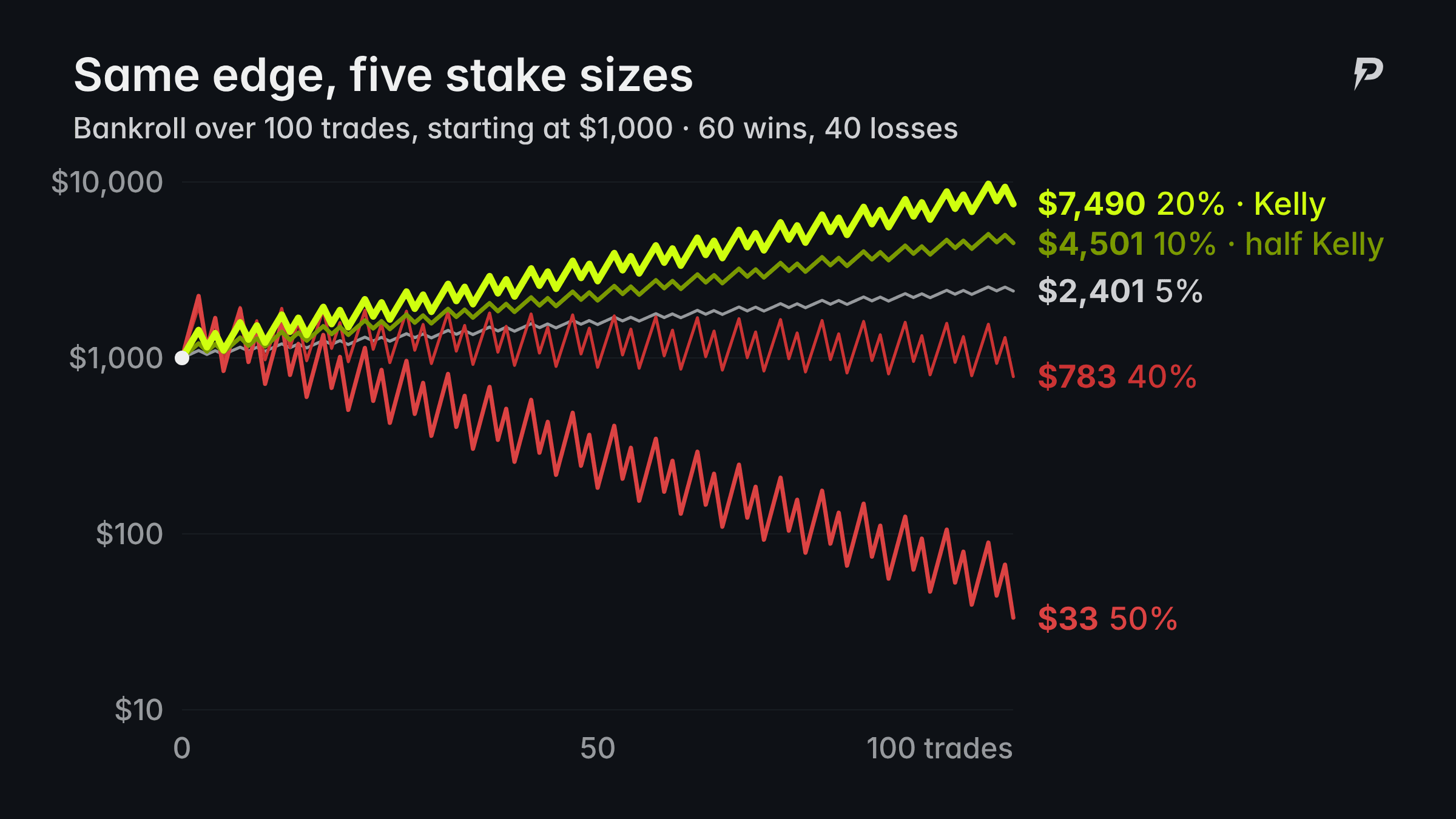
At 40% you lose money with a winning strategy. At 50% you're almost wiped out. The reason is that losses hurt more than wins help: win 50% then lose 50% and you're at 75% of where you started, not 100%.
The lesson: an edge only pays if you survive long enough to collect it. Sizing is how you survive.
Bankroll and units
Start by deciding your bankroll: the money set aside for trading that you can afford to lose entirely. Not your savings, not rent.
Then think in units, a fixed share of that bankroll. A common choice is 1–2% per unit. With a $1,000 bankroll, a unit is $10–$20.
Units do two things. They stop you from sizing on mood ("I'm really sure about this one"), and they make your results comparable across time. When the bankroll grows or shrinks a lot, recalculate the unit.
The Kelly criterion for prediction markets
Kelly is a formula for the stake that grows your bankroll fastest over the long run, given your edge. For a share that costs c and pays $1, where you think the true probability is p:
f* = (p − c) / (1 − c)
f* is the fraction of your bankroll to spend on the shares. The top part, p − c, is your expected profit per share before fees. If you're new to that idea, prediction market odds and probability covers expected value in more detail.
Worked examples (bankroll $1,000)
1. A coin flip you think is underpriced. Price 50¢, your estimate 60%. f* = (0.60 − 0.50) / (1 − 0.50) = 0.10 / 0.50 = 20%. Spend $200, which buys 400 shares.
2. A long shot. Price 20¢, your estimate 30%. f* = (0.30 − 0.20) / (1 − 0.20) = 0.10 / 0.80 = 12.5%. Spend $125, which buys 625 shares.
3. A heavy favourite. Price 85¢, your estimate 90%. f* = (0.90 − 0.85) / (1 − 0.85) = 0.05 / 0.15 = 33%. Kelly says spend $333 on a 5-point edge.
4. No edge. Price 50¢, your estimate 45%. f* = (0.45 − 0.50) / 0.50 = −20%. A negative result means don't buy. You might look at the other side instead: if No costs 50¢ and you give it 55%, Kelly on No is 10%.
Include fees in the price. A market order on Preddy carries a 0.5% taker fee, so a 50¢ share effectively costs 50.25¢, and example 1 drops from 20% to about 19.6%. Limit orders have no Preddy fee. See fees.
Why most people use half or quarter Kelly
Kelly assumes your probability is correct. It never is exactly, and Kelly punishes overconfidence hard.
Look at example 3 again. If the true probability is 85% instead of your 90%, the edge is zero, and you've put a third of your bankroll on a fair price that loses 15% of the time. If it's 82%, Kelly would say don't bet at all, yet you're in for $333.
That's why most traders use half Kelly (example 1: $100) or quarter Kelly ($50). You give up some growth, but less than you'd expect: in the coin-flip example, half Kelly keeps about three-quarters of the long-run growth rate. In the table that's the 10% row, $4,501 instead of $7,490, with much shallower drops along the way. Overbetting is the expensive mistake. Doubling Kelly in that same example (the 40% row) turns a winning edge into a loss.
A useful habit: write down your probability before you look at the price. If your estimates keep landing a point or two from the market, your edge is probably smaller than you think.
Correlated positions are one bet
Three positions on the same game are not three bets. If you hold Yes on "Team A wins the final," Yes on "Team A wins by 2+," and No on "Team B wins the final," they all lose together. At 3% each, that's 9% of your bankroll on one result.
The same goes for an election: a candidate winning, their party taking a majority, and a related policy market often move as one. Add up everything that wins or loses on the same outcome and size the total, not each piece. Multi-outcome events are a common trap here; see multi-outcome markets.
Liquidity risk: can you get out?
Your position is only worth what someone will pay for it. In a thin market, the best bid might be several cents below the last price, with only a few hundred dollars behind it. Selling a large position means walking down the book.
Before you size up, look at the bids. If you couldn't exit at a reasonable price, treat the position as one you'll hold to resolution, and size it accordingly. Market vs limit orders explains spreads and slippage.
Resolution risk: read the rules
A market pays out by its written rules, not by what the title seems to mean. Edge cases (a postponed game, an ambiguous announcement, a source that publishes late) can turn a "sure thing" into a loss or a long wait. Read the rules before sizing anything large. More in how prediction markets resolve.
The 95¢ trap
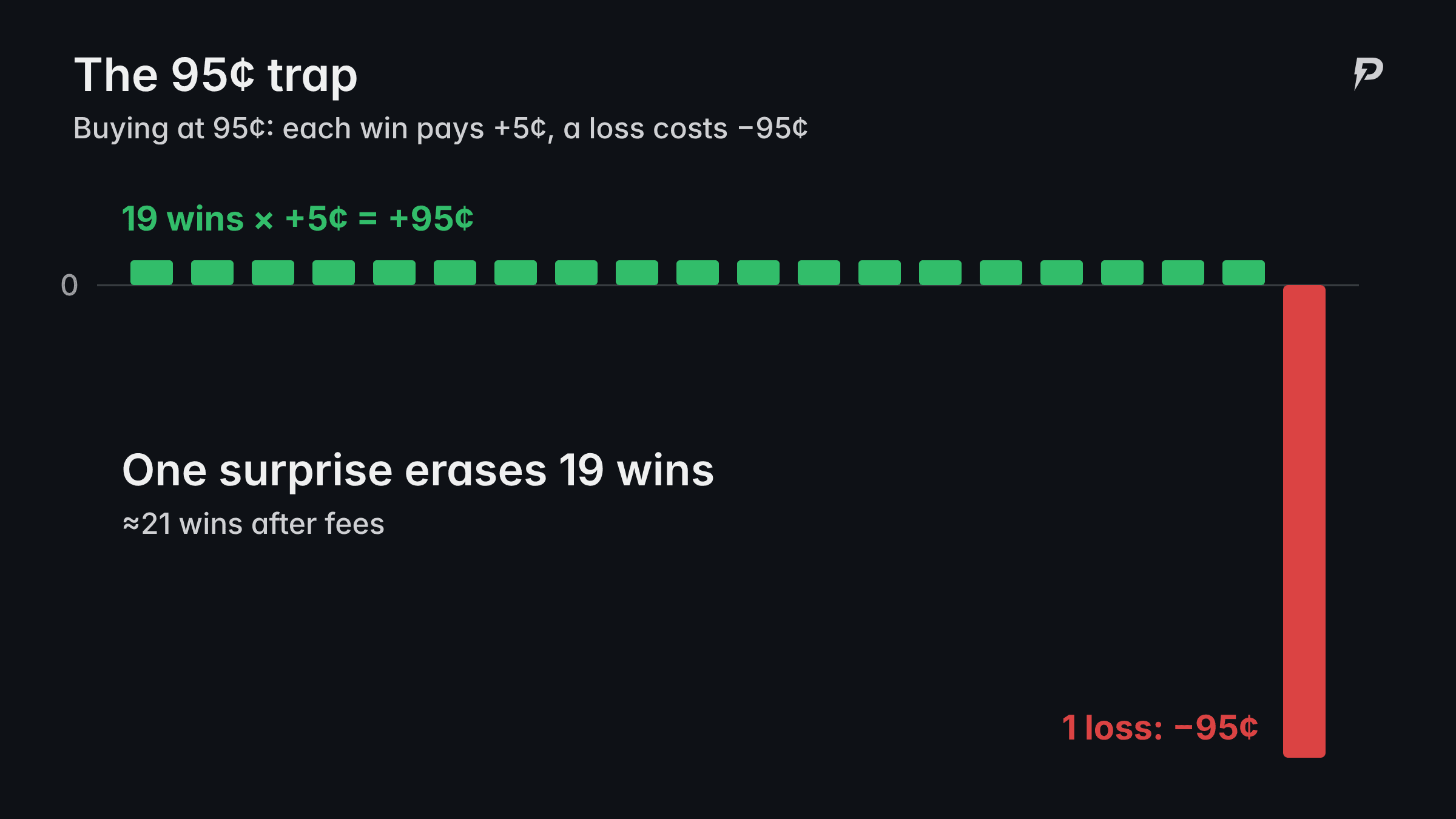
Buying at 95¢ feels safe. It rarely loses. But look at the payoff: you risk 95¢ to make 5¢.
Put $950 into shares at 95¢ and you hold 1,000 shares. If they win, you make $50. If they lose, you lose $950. One surprise wipes out 19 wins. Add the 0.5% taker fee on a market order and your cost per share becomes about 95.5¢, your profit about 4.5¢, and it takes about 21 wins to cover one loss.
At 95¢, the price says the outcome happens 95% of the time. For the trade to be worth it, you need it to be meaningfully more likely than that, and you need to be right about it. Tiny edges with big downside are exactly where estimate errors hurt most. Size these small, or skip them.
Common position sizing mistakes
- Averaging down without new information. A falling price is information, and it often means someone knows something you don't. Add only if your reason for the trade still holds after you've found out why it moved.
- Revenge trading. After a loss, the urge is to win it back with a bigger bet. That's the 50% row in the table above.
- Overconcentration. One market, or one theme, holding most of your bankroll. See correlation above.
- Ignoring fees. On small edges, a 0.5% taker fee plus the spread can eat most of your expected profit. Use limit orders when you aren't in a hurry.
- Holding to resolution by default. You can sell any time. If the price has moved to where you think it's fair, the edge is gone, and holding just adds risk.
Do stop losses work in prediction markets?
Sometimes. It depends on how the price moves.
They help when prices drift: a market slowly losing ground over days while you can't watch it, or when you want a hard rule that takes emotion out of the exit.
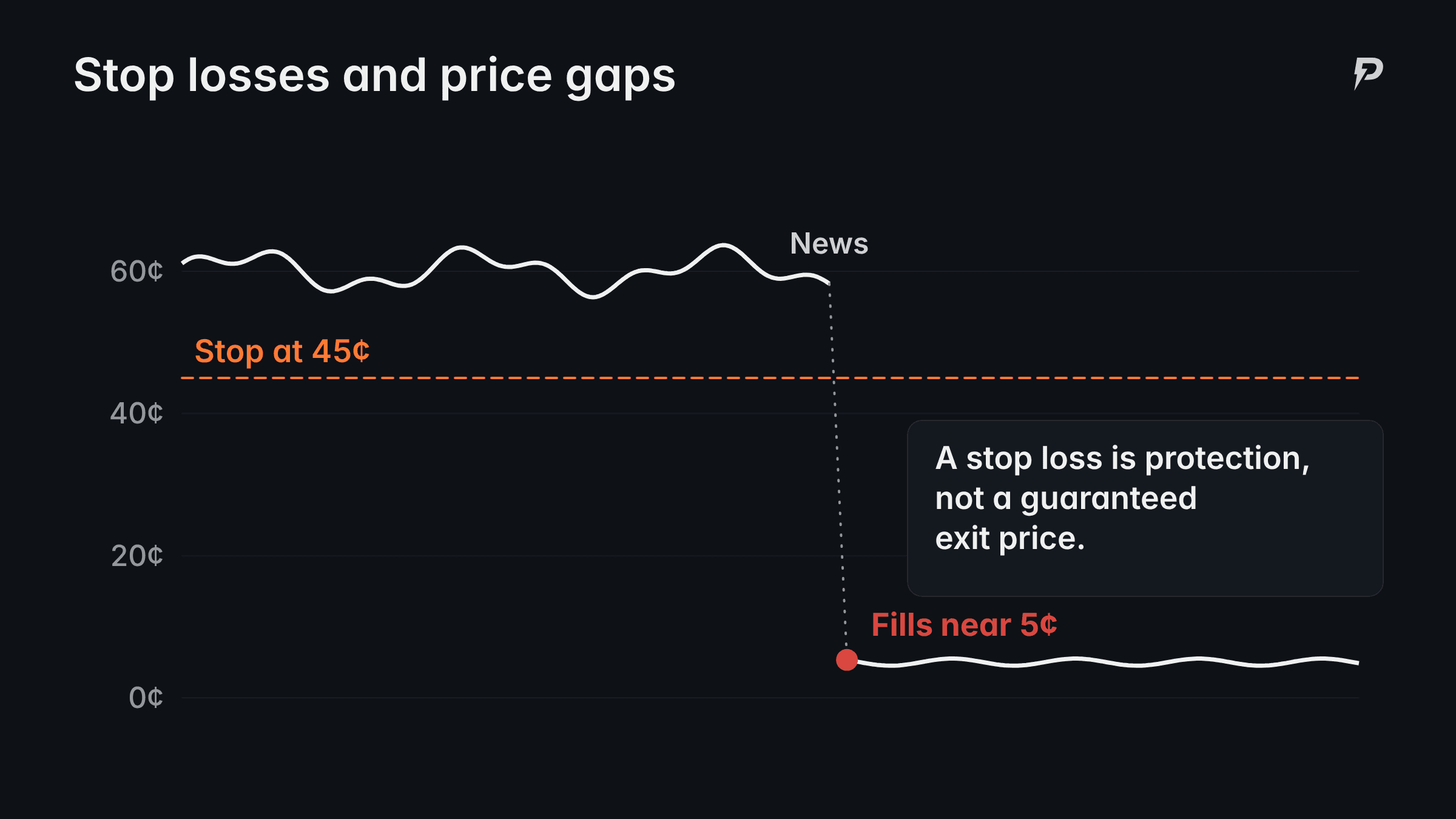
They don't help much when prices gap. Prediction markets often move in jumps on news: a result is announced, a goal is scored, a ruling comes out. A price can go from 60¢ to 5¢ with almost no trades in between. A stop loss at 45¢ triggers, but it sells at whatever bids are left, which may be close to 5¢.
Thin books are the other problem. A single small trade at a low price can trigger your stop, and then your sell walks down a shallow book.
On Preddy, a stop loss watches trades in that market and, once the price trades at or below your trigger, sells with a market order. If there isn't enough liquidity, the filled part sells and the rest stays active. Executions carry the 0.5% taker fee. It's protection, not a guaranteed exit price. You can set more than one at different levels, for example half your position at 40¢ and the rest at 25¢. Details in the stop losses docs.
Alerts: a lighter alternative
If a forced sale into a thin book worries you, use an alert instead. A price alert or a volatility alert tells you when the market crosses a level or swings sharply, in-app or on Telegram, and you decide what to do. You keep control and can check the news before you sell. See alerts.
A practical position sizing checklist
Before each trade:
- Write down your probability before looking at the price.
- Compute the edge: p − c, with fees included.
- Run Kelly, then use half or quarter. Negative means no trade.
- Cap it at your maximum per-position size, whatever Kelly says.
- Add up correlated positions and check the total.
- Check the bids: could you exit if you needed to?
- Read the resolution rules.
- Decide your exit in advance: a target, a stop loss, an alert, or holding to resolution on purpose.
None of this is financial advice. It's a way to make sure a few bad outcomes can't knock you out of the game.
When you're ready to put it into practice, browse markets on Preddy and start small.