How prediction markets resolve (and what happens when it's disputed)
How prediction markets resolve on Polymarket: the rules, the UMA oracle, the challenge window, disputes, 50-50 outcomes and redeeming your winnings.
By Preddy Team
A share in a prediction market pays $1 if its outcome happens and $0 if it doesn't. Simple, until you ask who decides what "happened" means. The answer is not the news, not the crowd and not your gut. It's the market's written rules, applied by an oracle.
This post walks through how that works on Polymarket markets (which is where trades placed through Preddy settle), what you'll see on the screen while a result is pending, and how to avoid the most common way traders lose money on a call they got "right".
Why you should read the rules before you trade
Every market has a rules section. It usually says three things:
- The exact question. What counts as YES, worded more precisely than the title.
- The deadline. The date and time (with a timezone) by which it has to happen.
- The resolution source. Where the answer comes from: an official announcement, a specific data provider, a league's official result.
The title is a summary. The rules are the contract. Most avoidable losses come from the gap between the two.
A hypothetical: "Will Company X launch its new phone by March 31?" You see a leaked retail listing on March 28 and buy YES at 85¢. But the rules say the market resolves YES only on an official announcement from Company X, and the company announces on April 2. The market resolves NO. You were right about the phone and still lost.
Price markets have the same trap. "Will BTC hit $150,000?" can mean a one-minute candle on one exchange, a daily close or an index price, and a wick on a different exchange may not count.
If the title says one thing and the rules say another, the rules win. Every time.
The lifecycle of a market, from trading to payout
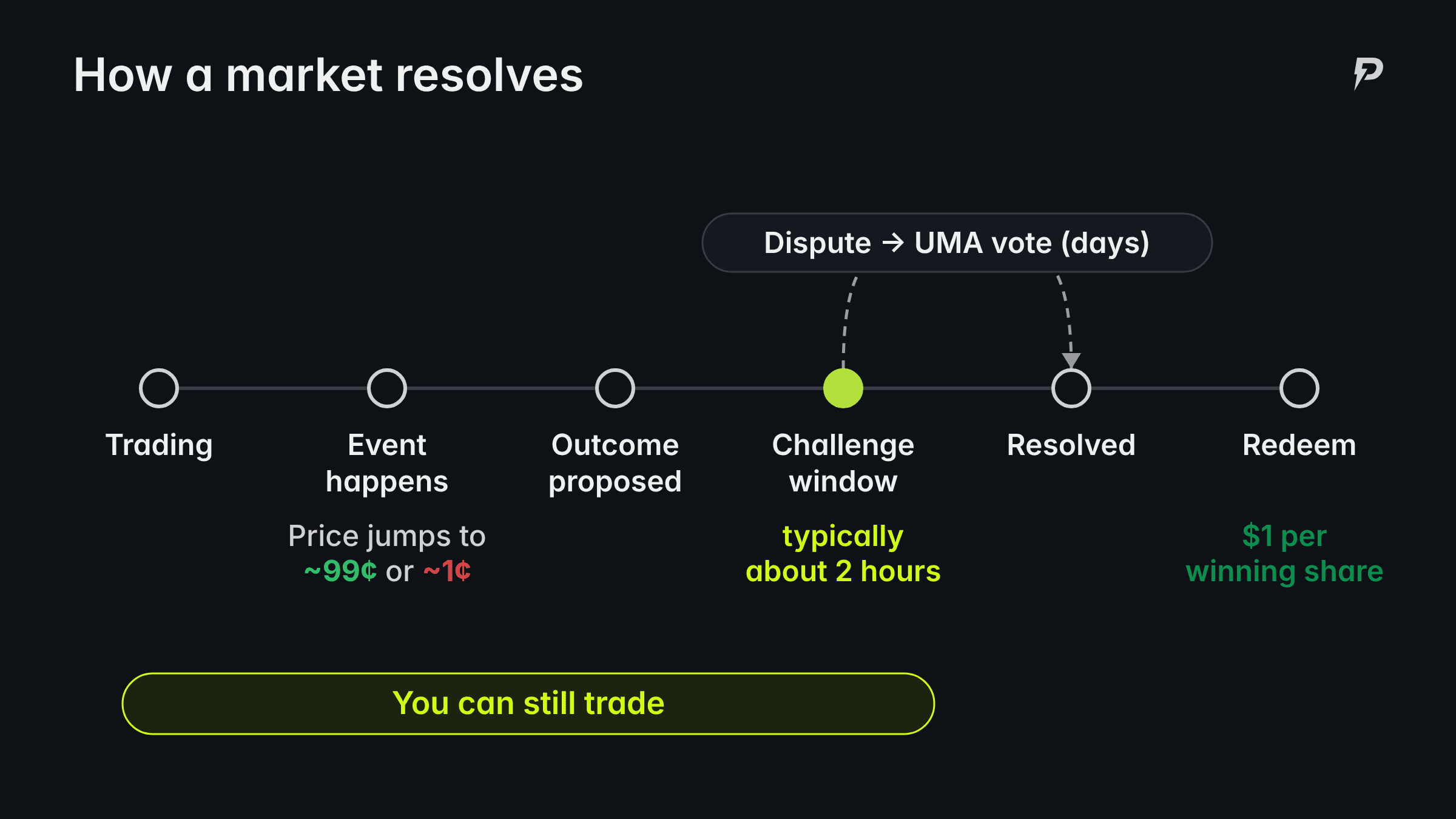
| Stage | What happens | What you can do |
|---|---|---|
| Trading | The market is open, prices move with news. | Buy, sell, place limit orders. |
| Event happens | The result becomes known, or the deadline passes. | Usually still trade. Prices jump toward 99¢ / 1¢. |
| Outcome proposed | Someone submits the result to the oracle and posts a bond. | Trade, or wait. |
| Challenge window | Anyone can dispute the proposal, typically for about 2 hours. | Trade, or wait. |
| Resolved | The result is final. Trading stops. | Nothing left to trade. |
| Redeem | Winning shares are exchanged for $1 each. | Claim your payout. |
Two details catch people out. First, "by" markets can resolve early: if the question is "Will X happen by December 31?" and X happens in October, the market doesn't need to wait for December. Second, there's often a gap between the game ending and the market resolving. The final whistle isn't the payout. The oracle is.
How Polymarket markets resolve: the UMA Optimistic Oracle
Polymarket markets are resolved through UMA's Optimistic Oracle. "Optimistic" means the system assumes a proposed answer is correct unless somebody objects. In plain terms:
- A proposer submits the outcome (YES, NO, or whatever the rules allow) and locks up a bond as a guarantee.
- A challenge window opens, usually around two hours. During it, anyone who thinks the proposal is wrong can dispute it by posting a bond of their own.
- No dispute? The proposal becomes final when the window closes. Most markets resolve this way.
- Disputed? Depending on the market setup, a fresh proposal round may come first. If it's still contested, the question goes to a vote of UMA token holders, which takes days, not hours.
- Whoever was wrong loses their bond to the side that was right.
The bond is the point. Proposing a false result, or disputing a correct one, costs real money. That makes honest proposals the cheap, boring default.
Voters aren't asked what they feel happened. They're asked what the rules and the named resolution source say. A market with sloppy wording is far more likely to end up in a vote.
Why prices sit at 97–99¢ after the event is over
The match is over, your team won, and YES is trading at 98¢ instead of $1. Nobody's asleep. Three things are priced in:
Time value. If you buy at 98¢ and redeem for $1 in three days, you made 2¢ on 98¢, about 2%. That's a decent return for three days, but someone has to be willing to lock up money for it.
Resolution risk. A small chance the proposal gets disputed, the wording gets argued, or the result flips. Using the expected-value rule from our odds and probability guide, EV per share = p − c. Buying at 98¢ only makes sense if you think the chance of a $1 payout is above 98%.
Lockup risk. If the market goes to a vote, your money is stuck for days. During that time prices can swing hard on every rumour about which way it's going.
If you're the one holding winning shares, you face the opposite choice. Say you hold 500 YES shares:
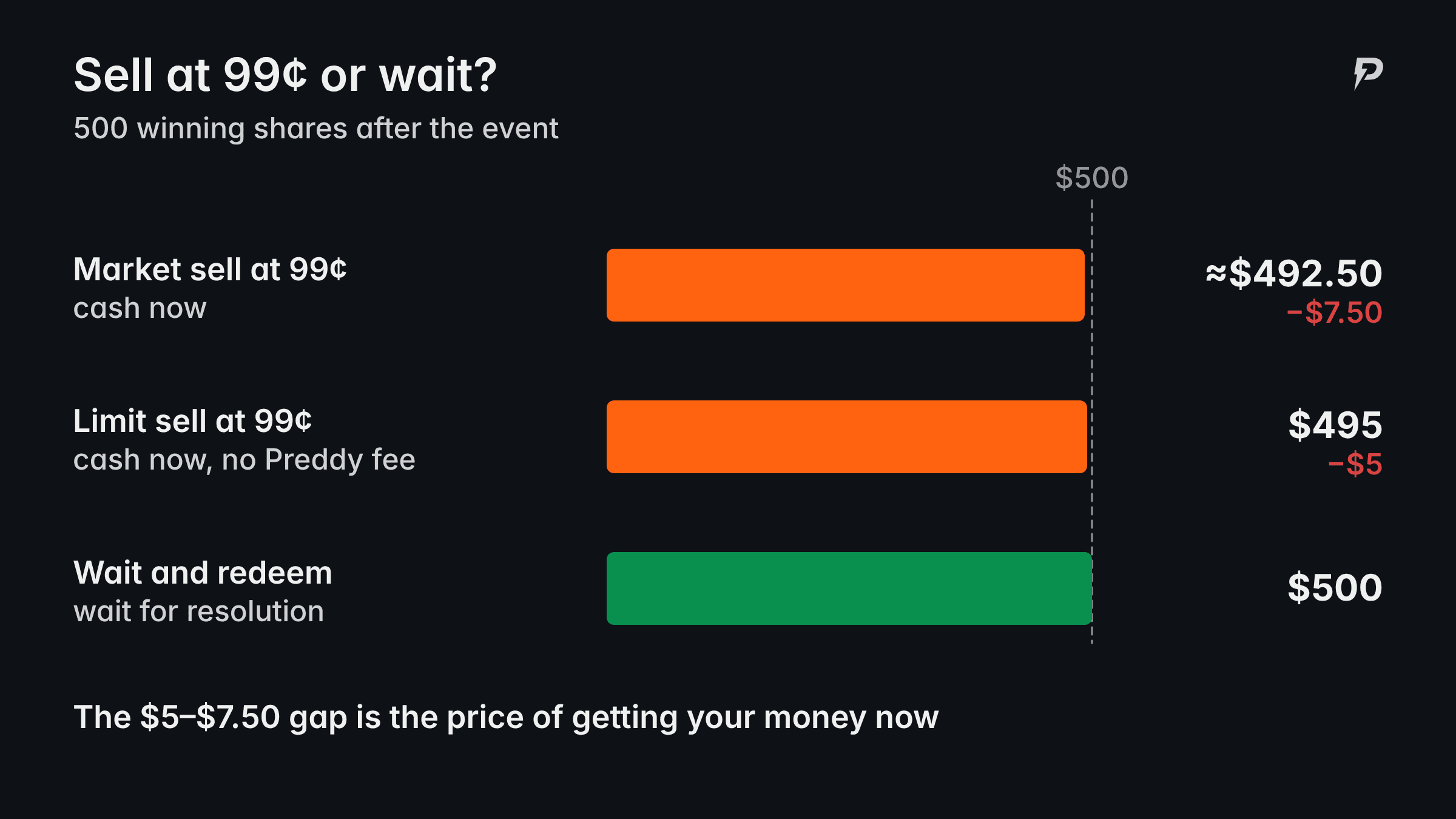
| Option | You get | Notes |
|---|---|---|
| Sell now at 99¢ (market order) | $495 minus the 0.5% Preddy taker fee (about $2.48), so roughly $492.50 | Money free immediately |
| Sell now at 99¢ (limit order that fills) | $495 | No Preddy fee on limit orders |
| Wait and redeem | $500 | Wait for resolution, carry the small risk |
Neither is wrong. Selling at 99¢ gives up $5 and frees the cash for your next trade. Waiting earns that $5 for carrying the last bit of risk. If a dispute looks likely, the 1¢ is cheap insurance. The fees page has the full table, and our guide to market vs limit orders explains when each one makes sense.
What happens when a market is disputed?
From a trader's seat, a dispute looks like this:
- The price that was pinned at 99¢ drops, sometimes sharply, as traders price in the chance the result flips.
- Liquidity thins. Spreads widen, and selling a large position gets expensive.
- Your capital is tied up until the final answer. If you were counting on that $1 to fund your next trade, you'll be waiting.
- Final means final. After a vote settles it, the market pays out according to that result, even if you disagree.
The practical lesson: size positions so a few days of lockup won't hurt you, especially in markets whose rules feel loose. Our post on position sizing and risk covers this in more detail.
Edge cases: ambiguous wording, cancellations and 50-50
Ambiguous wording. "Will X meet Y?" Does a video call count? A brief encounter at a summit? If you can argue both sides, so can the proposer and the disputer. Either price that ambiguity in or stay out.
Cancelled or postponed events. Good rules say what happens. Common patterns: the market resolves NO if the event doesn't happen by the deadline, or a sports market keeps waiting for a rescheduled game up to a cutoff. Don't assume. Check.
50-50 resolutions. Some markets' rules allow a 50-50 resolution, typically when an event is cancelled or can't be determined. Then every YES and every NO share pays 50¢. If you bought YES at 30¢, you make 20¢ per share. If you bought at 70¢, you lose 20¢. Whether 50-50 is possible depends entirely on that market's rules.
Clarifications. Markets sometimes get clarifications added to their rules after launch, when something unexpected comes up. If you hold a position for weeks, reread the rules before you add to it.
How to redeem winning shares
Once a market is resolved, each winning share is worth exactly $1 and each losing share is worth $0. Losing shares have nothing to redeem. They simply close out as a loss. Winning shares need to be redeemed (claimed) to turn them into cash in your balance.
On Preddy that's one press: a Claim button appears next to your balance, and Portfolio has Claim All. Our claim winnings lesson walks through it. If you'd rather not do it by hand, turn on Auto-Redeem in Settings and winning positions are claimed for you once markets resolve.
To know the moment a market settles, add a Resolution alert on it. It can reach you in the app or on Telegram. See the alerts docs for setup.
A checklist for reading market rules
Before you buy, spend two minutes on this:
- Read the full rules, not the title. Find the exact condition for YES.
- Find the resolution source. Is it a single named source? Could it be slow, change its numbers or go offline?
- Check the deadline and timezone. "By March 31" in which timezone, and inclusive or not?
- Look for the cancellation clause. NO, a 50-50 or waiting for a rescheduled date?
- Hunt for ambiguity. Can you write a plausible argument for the other side? Then a disputer can too.
- Check for clarifications added since the market launched.
- Ask what happens if it ends up in a dispute. Can you afford to have this money stuck for a few days?
If the market still looks good after all that, browse open markets on Preddy and trade it with the full picture.
Keep reading
What are prediction markets?
How they work, who trades them and why prices mean something.
Odds and probability
Read prices as probabilities and work out expected value.
Multi-outcome markets
Why outcomes add up to about 100% and what to do when they don't.
Glossary
Every term you'll run into, in plain words.