What are prediction markets and how do they work?
How prediction markets work: shares that pay $1 if you're right, prices that read as probabilities, and a worked example from buy to payout.
By Preddy Team
A prediction market lets you trade on the outcome of a future event. Will the Fed cut rates at its next meeting? Will this team win the final? Will Bitcoin close the month above a certain price? Each question becomes a market, and you buy shares in the answer you think is right. If you're right, you get paid. If you're wrong, you lose what you put in.
Here's how the mechanics work, what the prices mean, and where people go wrong.
How does a prediction market work?
Every market is a yes-or-no question with two kinds of shares: YES and NO.
- If the event happens, each YES share pays $1 and each NO share pays $0.
- If it doesn't, each NO share pays $1 and each YES share pays $0.
That's the whole payout rule. There are no odds to calculate at the end and no bookmaker deciding how much you win. A winning share is worth a dollar, a losing share is worth nothing.
Before the outcome is known, shares trade somewhere between 1¢ and 99¢, and the price tells you a lot.
What does the price of a share mean?
Because a share pays exactly $1 if it wins, its price reads as the market's estimate of the probability. A YES share trading at 62¢ means traders, collectively, think the event has roughly a 62% chance.
Think about why. If you believed the real chance was 80%, a share costing 62¢ would be a bargain: on average it pays 80¢. You'd buy. If you believed the chance was 40%, you'd sell or buy NO instead. The price settles where buyers and sellers stop finding it cheap or expensive. That is the market-implied probability.
YES and NO prices are two sides of the same coin, so they add up to about $1. If YES is 62¢, NO is around 38¢.
The price on a market page is usually the midpoint between the best buy and sell offers. When you buy, you pay the lowest price someone is willing to sell at, which is a little higher. The gap is called the spread, and in quiet markets it can be several cents. Market vs limit orders explains how to avoid paying it.
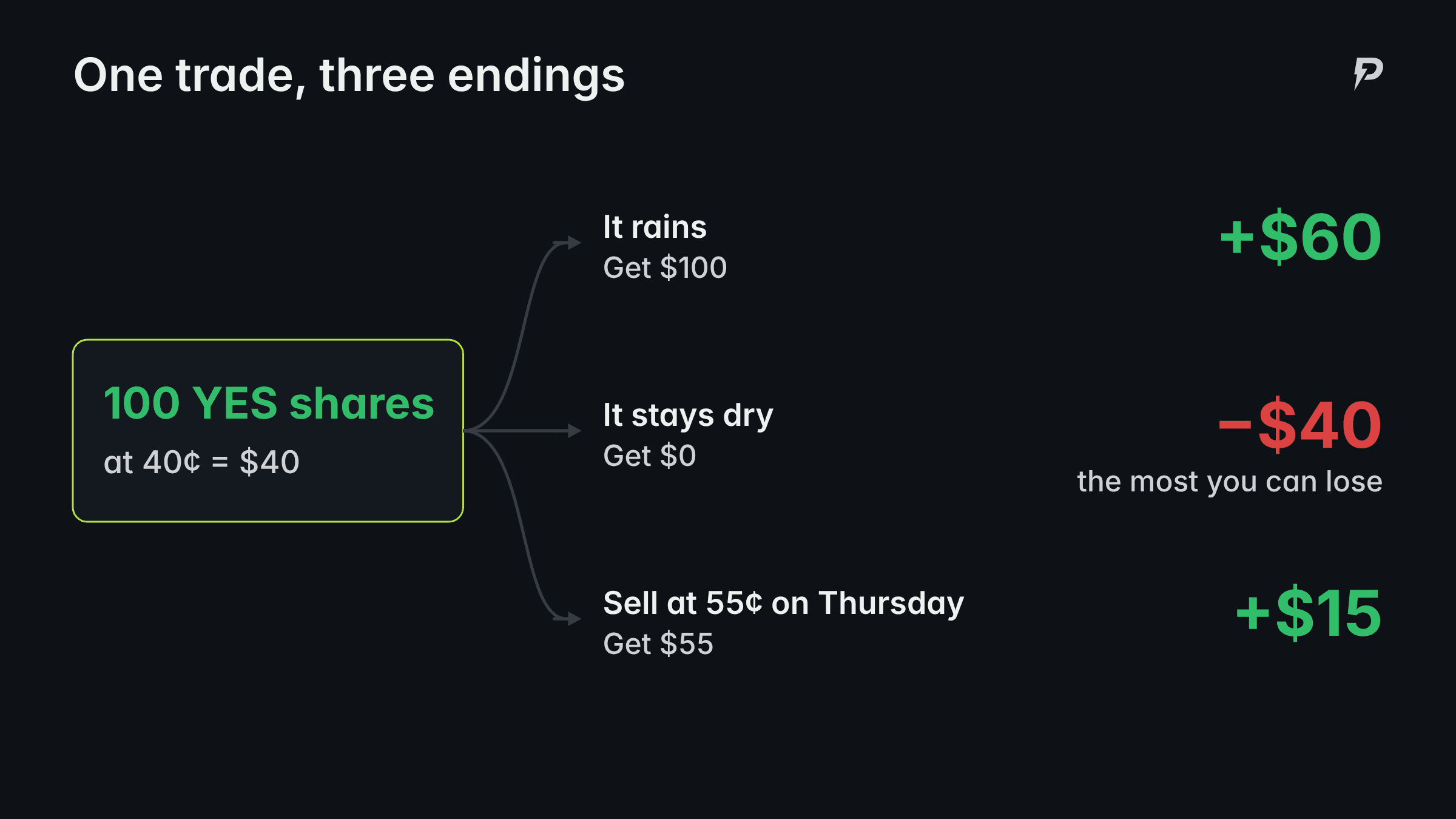
A worked example: one trade, three endings
Say there's a market: "Will it rain in London on Saturday?" (a hypothetical, for illustration). YES trades at 40¢.
You think the forecast looks wetter than that, so you buy 100 YES shares at 40¢. Cost: $40.
Ending 1: it rains. Each share pays $1. You get $100 back, a $60 profit on $40.
Ending 2: it stays dry. Your shares pay $0. You lose the $40. That's the most you can lose: you can never owe more than you paid.
Ending 3: you sell early. On Thursday, an updated forecast pushes YES up to 55¢. You sell your 100 shares at 55¢ for $55 and walk away with a $15 profit without waiting for Saturday at all.
| You paid | You get | Profit | |
|---|---|---|---|
| It rains | $40 | $100 | +$60 |
| It stays dry | $40 | $0 | −$40 |
| Sell at 55¢ on Thursday | $40 | $55 | +$15 |
These numbers are before fees. On Preddy, market orders carry a 0.5% taker fee (20¢ on a $40 order) and limit orders are free. Some markets also carry their own fees, so check before you trade. The details are on the fees page.
To turn a price into odds or decide whether a trade is worth taking, see prediction market odds and probability.
Why do prices move?
Prices move for two reasons.
New information. A poll comes out, a player gets injured, an economic report lands, a forecast changes. Traders who react first buy or sell, and the price jumps to reflect the new picture. On a live sports market, a single goal can move a price from 50¢ to 80¢ in seconds.
Money. Even without news, a large buyer can push the price up by working through every seller willing to sell at the current price. Sometimes that buyer knows something. Sometimes they're just a big fan with a big wallet. A price move on thin volume tells you less than one backed by many independent traders.
As the event gets closer, prices tend to drift toward 0¢ or 100¢. A market that resolves tomorrow has much less uncertainty left in it than one that resolves next year.
Can you sell before the market resolves?
Yes, and this is one of the biggest differences from a traditional bet. Your shares are tradable at any time until the market closes. You can:
- Take profit when the price has moved your way, like in the example above.
- Cut a loss when the news turns against you. Selling at 25¢ beats holding to $0.
- Trade the swings without ever holding to the end.
Getting out early only works if someone is buying, though. In a busy market that's rarely a problem. In a quiet one, you may have to accept a worse price to exit. If you can't watch a position all day, a stop loss sells it automatically when the price drops to a level you choose.
Who is on the other side of your trade?
Other traders. Prediction markets are peer-to-peer: buy orders and sell orders meet in an orderbook, and every trade has a real person (or a trading bot) on the other side. There's no house setting the odds and no bookmaker who profits when you lose.
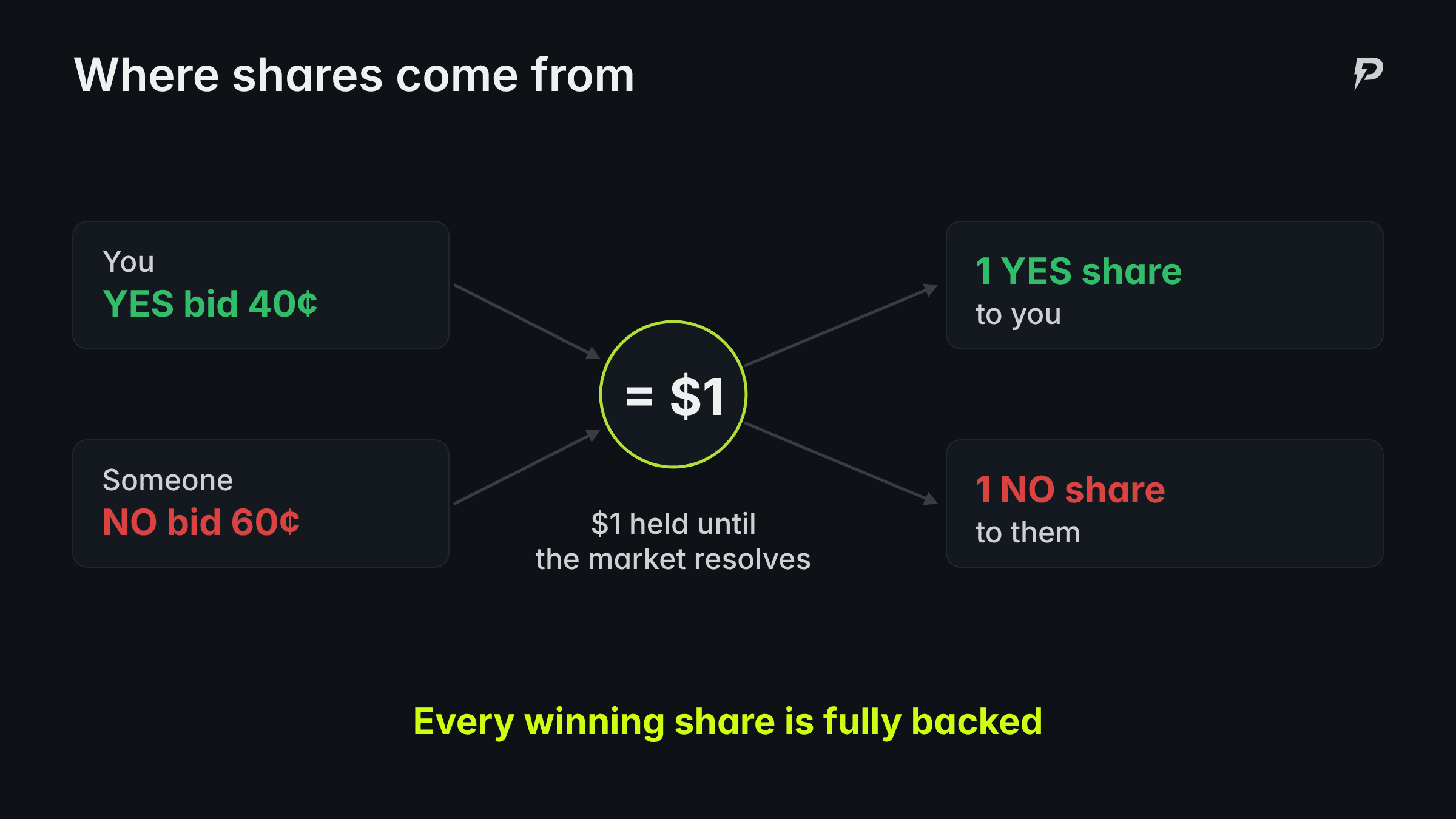
New shares get created when a YES buyer and a NO buyer agree on prices that add up to $1. Say you bid 40¢ for YES and someone else bids 60¢ for NO. Together that's $1, which is exactly what one pair of shares will pay out, since only one side can win. The pair is created, you each get your share, and the $1 is held until the market resolves. This is why every winning share is always fully backed.
The markets you trade through Preddy run on Polymarket. Preddy routes your orders to Polymarket's orderbook, so you trade against the same pool of buyers and sellers, with extra tools on top.
Why are prediction markets often accurate?
Because being wrong costs money. A pundit can make a bad call on TV and keep their job. A trader who keeps buying overpriced shares loses their bankroll and stops affecting the price. Over time, money flows toward people who are right more often.
Markets also combine many scraps of information into one number. One trader has read the polls, another knows the local politics, a third spotted a mispricing between two related markets. Each of them trades on what they know, and the price absorbs all of it.
And when the price is clearly wrong, that's an opportunity, which is exactly what attracts people to fix it.
When are prediction markets wrong?
Often enough that you shouldn't treat a price as the truth. Watch for these:
- Thin markets. A market with little money in it can be moved by one trader. Its price might be one person's opinion, not a crowd's.
- Bias. Fans overrate their own team. Traders tend to overpay for long shots. Popular stories attract one-sided money.
- Ambiguous rules. The question you think you're trading might not be the one the rules describe. "Will X announce Y?" depends on what counts as an announcement. Always read the resolution rules; how prediction markets resolve explains what to look for.
- Misreading probability. A 90% favourite still loses one time in ten. If it loses, the market wasn't necessarily wrong. Judge a market by how its prices hold up across many events, not by one result.
What kinds of prediction markets are there?
Almost anything with a clear, checkable answer:
- Politics: elections, primaries, cabinet picks, whether a bill passes.
- Sports: match winners, totals, tournament winners, often traded live during the game.
- Crypto: where Bitcoin or Ethereum will trade by a date, including short up-or-down markets that settle within minutes or hours.
- Economics: interest rate decisions, inflation prints, jobs numbers.
- Culture: award winners, box office, what a public figure will post.
- Weather: daily high temperatures in big cities, rainfall, hurricane landfalls.
Some questions have many possible answers, like "Who will win the tournament?". Those are built as a set of yes-or-no markets, one per outcome, and their YES prices add up to about 100%. Multi-outcome markets explains how to trade them, including the trick of buying NO on a single candidate.
How to place your first trade
If you want to try it, start small. Pick a market you actually know something about, read the rules, and buy a few dollars of shares with a limit order. The first trade lesson walks through the betslip button by button. Watch how the price reacts to news. You'll learn more from one small position than from a dozen articles.
You can browse markets on Preddy and follow the step-by-step guide to trading with Preddy. New terms tripping you up? The prediction market glossary has plain definitions.
Keep reading
Odds and probability
Turn a price into odds, spot value and work out expected value.
Market vs limit orders
How the orderbook works and how to stop overpaying on every trade.
How markets resolve
Rules, the UMA oracle, disputes and getting paid.
Prediction markets vs sports betting
What changes when there's no bookmaker on the other side.