Prediction markets vs sports betting: what's actually different
Prediction markets vs sports betting, compared: who sets the price, who you bet against, margins, cash-out, limits, and which one suits you.
By Preddy Team
On the surface they look the same. You pick an outcome, put money down, and get paid if you're right. Plenty of prediction markets are about sports, too. But the machinery underneath is different, and it changes what you pay, who profits when you lose, and what happens when you start winning.
Here's how the two models actually differ, with the math you need to compare prices yourself.
Who sets the price?
At a bookmaker, the bookmaker does. Its traders and models set odds on every outcome, then adjust them as money comes in and news breaks. You can take the price or leave it. You can't propose your own.
On a prediction market, other traders do. Every market has an orderbook: people who want to buy post bids, people who want to sell post asks, and the price is wherever they meet. If you think a price is wrong, you can post your own order and wait for someone to take it. (If orderbooks are new to you, start with market vs limit orders.)
That's the root of almost every other difference on this list.
How to calculate a bookmaker's margin
Bookmaker odds aren't a pure forecast. They include a margin, also called the overround or vig, that guarantees the house an edge across all outcomes.
You can measure it yourself. Convert each decimal price to an implied probability (1 ÷ odds), add them up, and subtract 100%:
Margin = (1/odds₁ + 1/odds₂ + …) − 1
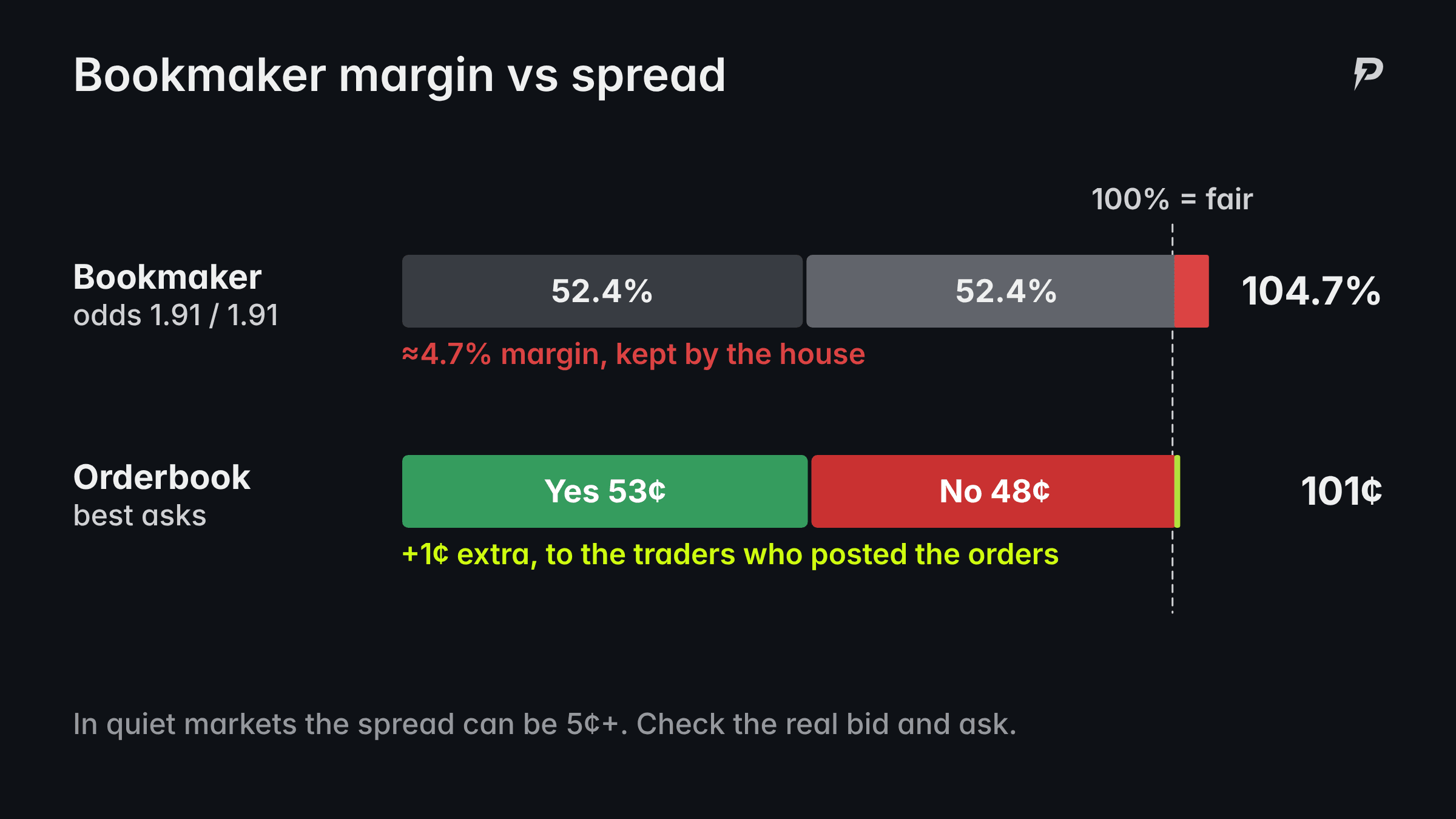
Take a coin-flip match priced at 1.91 / 1.91:
- 1 ÷ 1.91 = 52.36% for each side
- 52.36% + 52.36% = 104.71%
- Margin ≈ 4.7%
A fair price for a true 50/50 would be 2.00 on both sides. The gap between 2.00 and 1.91 is what the house keeps.
Three-way markets work the same way. A football match at 2.50 / 3.20 / 2.90 gives 40.00% + 31.25% + 34.48% = 105.73%, a margin of about 5.7%.
Run this on the lines you usually bet. Main markets on big events tend to carry thinner margins than niche lines and props, where margins are often much wider.
What's the prediction market equivalent?
The spread. Say a market shows Yes at 52¢ bid / 53¢ ask, and No at 47¢ bid / 48¢ ask. Buying Yes costs 53¢, buying No costs 48¢, and together that's 101¢ for a pair that pays exactly $1. That extra 1¢ is the "margin," and it goes to whichever traders posted those orders, not to a house.
In a busy market the spread can be a cent. In a quiet one it can be 5¢ or more, which is worse than a typical bookmaker line. Always check the actual bid and ask.
Who are you betting against?
At a bookmaker, you're betting against the house. When you lose, it keeps your stake; when you win, it pays you out of its own pocket. Its business depends on customers losing more than they win over time.
On a prediction market, you're trading against other people. On Polymarket, a Yes buyer at 60¢ and a No buyer at 40¢ together fund a pair of shares that will pay $1 to whichever side is right. The platform earns from activity, not from your losses, so it has no reason to care whether you win.
Betting exchanges sit in between: they're bookmaker-world companies that also match bettors against each other and take a commission. If you've used one, an orderbook will feel familiar.
Do bookmakers limit winning players?
It's a widely reported practice. Because the house is your counterparty, a customer who consistently beats its prices is a cost. Bettors who win regularly, especially by taking prices before the bookmaker moves them, often report having their maximum stakes cut, sometimes to tiny amounts, or their accounts closed.
On an orderbook, there's no house that loses when you win, so nobody has a motive to limit you. The practical cap is liquidity: you can only buy as many shares as other traders are willing to sell at a price you accept.
Cash-out vs selling your position
Both let you get out before the event ends. They work differently.
Bookmaker cash-out is an offer the bookmaker makes on your bet. It sets the number, it usually builds its margin into that number, and it can suspend cash-out at the moments you'd most want it, like right after a goal.
On a prediction market, you just sell. Your shares are an asset with a live price. Whatever the best bid is, you can sell into it, or post a limit order higher and wait.
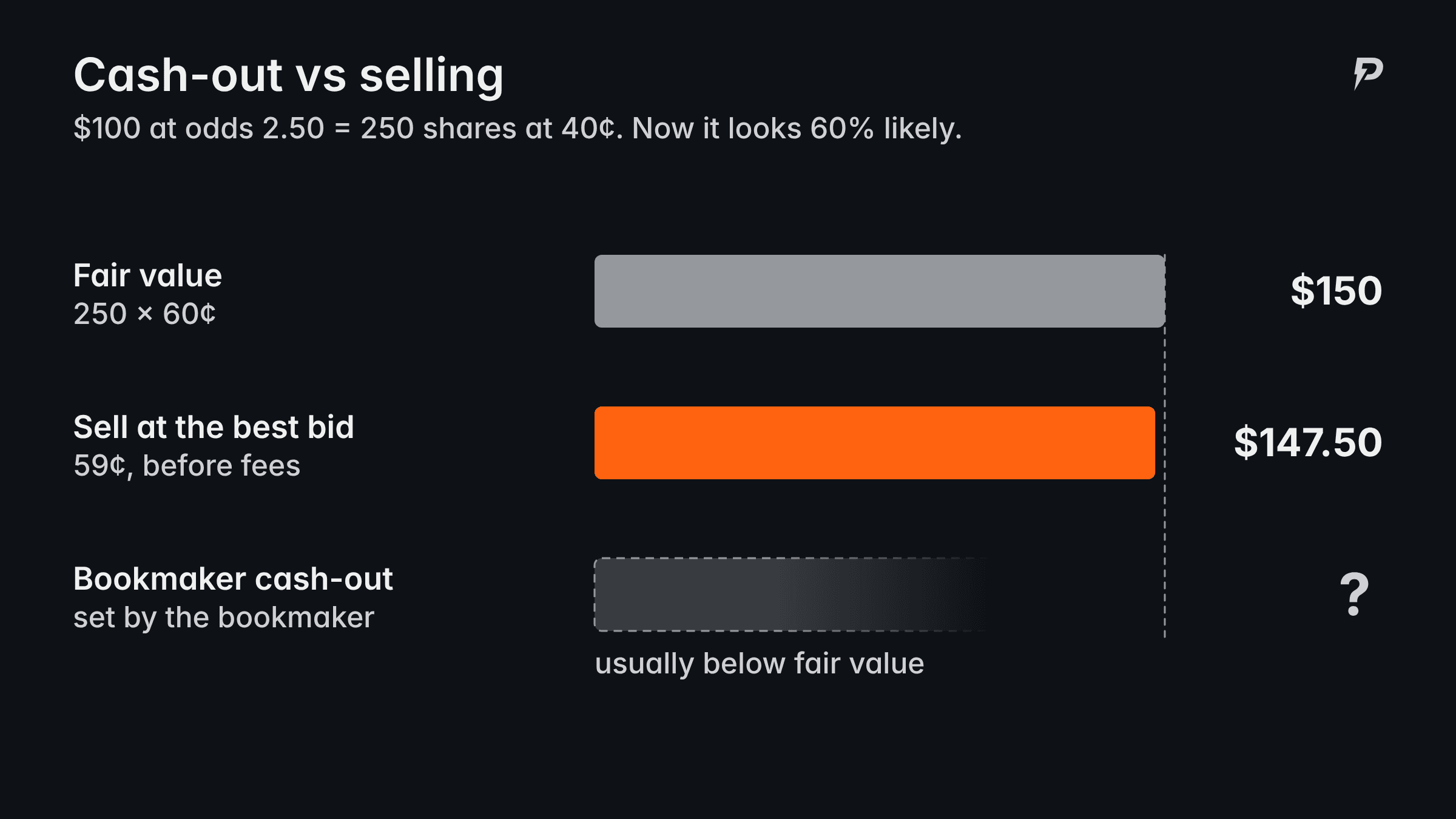
A hypothetical to make it concrete. You put $100 on an outcome at decimal odds 2.50, which is the same as buying 250 shares at 40¢. Midway through, the outcome now looks 60% likely:
- Fair value of your position: 250 × $0.60 = $150
- On a prediction market with a 59¢ best bid, you could sell for 250 × $0.59 = $147.50, before fees
- At a bookmaker, the cash-out offer is whatever it decides, and it's usually below fair value
Selling isn't always better. In a thin market the best bid might sit well under fair value too. But the price comes from competing traders, and you can see it before you act.
How to convert odds to cents (and back)
Prices on a prediction market are in cents, from 1¢ to 99¢, and each share pays $1 if it wins. Converting is one division either way:
- Cents → decimal odds: 1 ÷ price. 40¢ = 1 ÷ 0.40 = 2.50
- Decimal odds → cents: 1 ÷ odds. 1.25 = 1 ÷ 1.25 = 80¢
| Price | Implied probability | Decimal odds |
|---|---|---|
| 20¢ | 20% | 5.00 |
| 25¢ | 25% | 4.00 |
| 40¢ | 40% | 2.50 |
| 50¢ | 50% | 2.00 |
| 62¢ | 62% | 1.61 |
| 80¢ | 80% | 1.25 |
The payout matches too: $100 at 2.50 returns $250, and $100 at 40¢ buys 250 shares that return $250. The difference is that a bookmaker's 2.50 has the margin baked in, while 40¢ is just where traders currently agree. For more on reading prices and spotting value, see prediction market odds and probability.
What can you bet on?
Bookmakers are built around sports, with deep coverage: many leagues, hundreds of lines per match, player props, live in-play markets. Some also offer politics or entertainment specials.
Prediction markets cover sports too, but the range goes much further: elections, central bank decisions, economic data, crypto prices, weather, tech launches, culture. If there's a clear question with a verifiable answer, there may be a market on it. Browse what's live on Preddy events.
How a market settles also differs. A bookmaker settles under its own house rules. A prediction market resolves according to rules written on the market page, checked by an oracle process. Read those rules before you trade; the edge cases matter. More in how prediction markets resolve.
Where bookmakers are genuinely better
Being fair about it, bookmakers win on several things:
- Instant fills on niche lines. Want a corner-count bet on a second-division match? A bookmaker will quote it. A prediction market might not have it, or might have three people in the book.
- Live betting depth. Bookmakers run fast, deep in-play markets on many events at once.
- Bonuses and promotions. Free bets and boosted odds can be worth real money if you read the terms.
- Familiarity. Fiat deposits, a simple bet slip, no orderbook to learn.
Prediction markets win where the house model hurts you: thinner costs on busy markets, no limits for winning, and an exit at a market price instead of an offer.
Costs side by side
At a bookmaker, the main cost is the margin, and it's hidden inside the odds.
On a prediction market, you pay the spread plus any fees. Polymarket may charge fees on some market types. On Preddy, market orders carry a 0.5% taker fee, while limit orders, splits, and merges are free. Full details on the fees page.
A practical tip: if you're patient, use limit orders. You avoid crossing the spread and the taker fee in one move.
Prediction markets vs sports betting: comparison table
| Bookmaker | Prediction market | |
|---|---|---|
| Who sets the price | The bookmaker | Traders on an orderbook |
| Your counterparty | The house | Other traders |
| Main cost | Built-in margin | Spread + fees |
| Limits on winners | A widely reported practice | No house to limit you; liquidity is the cap |
| Exiting early | Cash-out offer, when available | Sell at the market price or post a limit |
| Can you set your own price? | No | Yes, with limit orders |
| Market range | Deep in sports | Sports plus politics, economics, crypto, culture and more |
| Niche and live lines | Strong | Varies; can be thin |
| Bonuses | Common | Less common |
| Settlement | House rules | Published market rules and an oracle |
Which one suits you?
A bookmaker suits you if you bet casually on sports, like the convenience, want live lines on smaller events, or plan to use promotions.
A prediction market suits you if you want to see what you're paying, expect to win often enough that limits would bite, like trading in and out as the price moves, or care about markets beyond sports.
Many people use both, and that's reasonable. If you do, the margin formula above is the single most useful habit to take with you: it tells you what the price really costs.
Rules for both differ by country, so check what applies where you live. Nothing here is financial advice.
Try it on a real market
If you want to see how an orderbook feels in practice, open a market on Preddy and compare its bid and ask to the odds you'd get elsewhere. The step-by-step guide walks you through your first trade.