How to read prediction market prices (and convert them to odds)
What a 30¢ price really means: prediction market prices as probability, converting cents to decimal, American and fractional odds, and expected value.
By Preddy Team
A share in a prediction market pays $1 if its outcome happens and $0 if it doesn't. That one rule is enough to read every price you see. If YES trades at 30¢, the market as a whole is saying "about a 30% chance". If you think the real chance is higher, the share is cheap. If you think it's lower, it's expensive.
Below: how to read that number, where it misleads you, how to turn it into bookmaker odds, and how to tell whether a trade is worth taking.
What does a prediction market price mean?
The price of a share is the market's implied probability of that outcome. A share costs between 1¢ and 99¢, and since it pays $1 when it wins, the price in cents reads directly as a percentage.
Take a market "Will it rain in London tomorrow?" with YES at 62¢:
- You pay 62¢ per YES share.
- If it rains, each share pays $1, so you make 38¢ per share.
- If it doesn't, the share is worth $0 and you lose your 62¢.
Paying 62¢ only breaks even if it rains at least 62% of the time, which is why 62¢ reads as "about 62%". Traders set the price, not a bookmaker, and you can sell at the current price any time before the market resolves.
If you're new to how these markets work in general, start with what prediction markets are.
YES at 70¢ and NO at 30¢: why they mirror each other
The two sides of a binary market add up to about $1. On Polymarket, where Preddy sends your orders, the contracts enforce it: one YES plus one NO can always be merged into $1, and $1 can always be split into one of each. If YES traded at 70¢ and NO at 40¢, anyone could split $1 and sell the pair for $1.10, so gaps like that close almost instantly.
So these are the same view of the world:
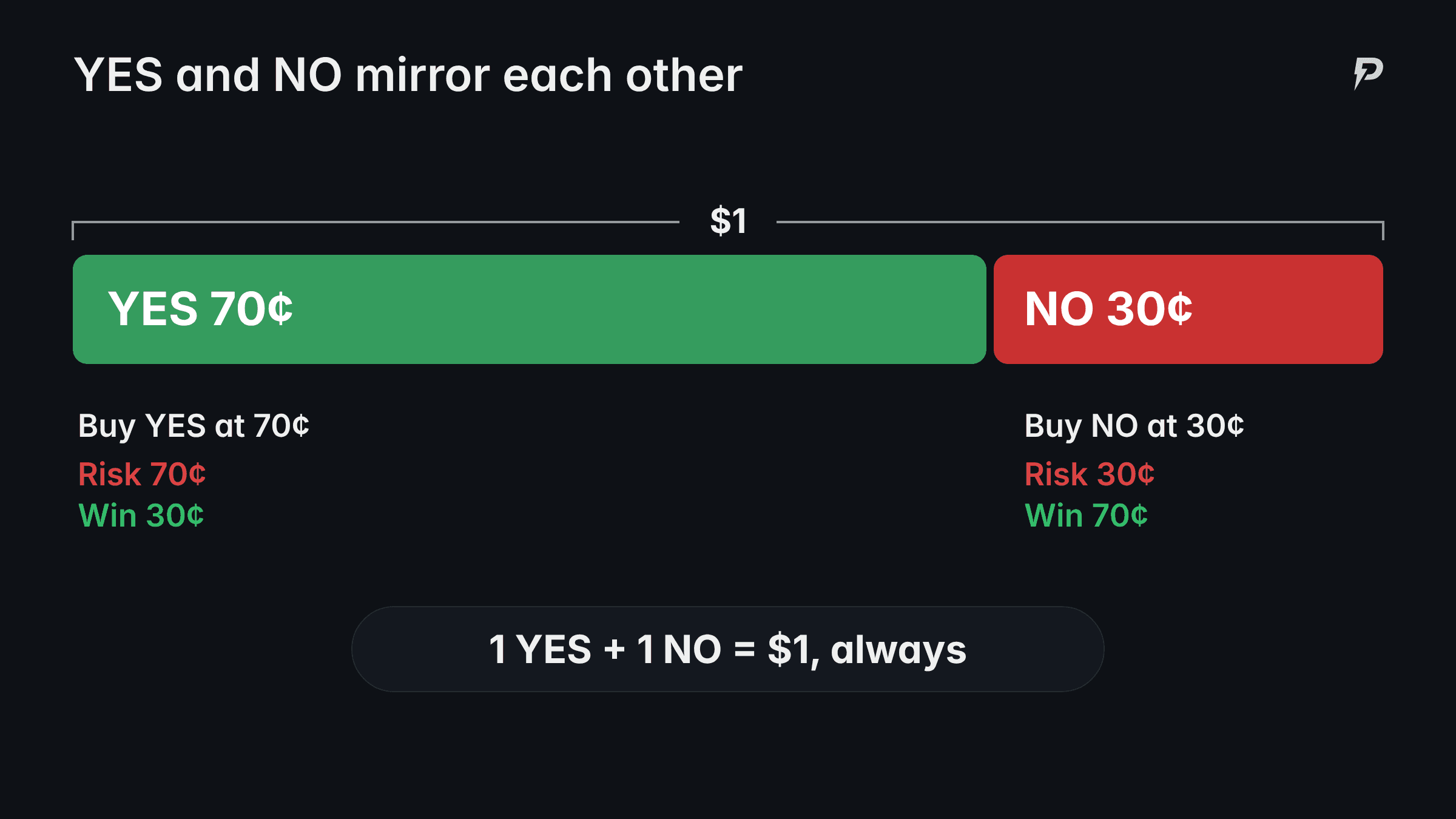
| You do this | You're betting | You risk | You can win |
|---|---|---|---|
| Buy YES at 70¢ | It happens | 70¢ | 30¢ |
| Buy NO at 30¢ | It doesn't happen | 30¢ | 70¢ |
The books are linked, too: an order to buy NO at 30¢ shows up as an offer to sell YES at 70¢. So you never need to own YES to bet against something: you just buy NO.
Mid price, last trade or best ask: which one should you read?
A market shows several prices at once, and they often disagree. Say the YES orderbook looks like this:
- Best bid: 58¢ (the most anyone will pay right now)
- Best ask: 62¢ (the least anyone will sell for right now)
- Mid price: 60¢ (halfway between)
- Last trade: 65¢ (an hour ago, before some news)
Each one answers a different question:
- Mid price is the best single guess at what the market thinks, as long as the spread is tight. Read this one for the probability.
- Best ask is what you'll actually pay to buy right now, and only for the size sitting at that price. Read this one before you buy.
- Best bid is what you'll get if you sell right now. Read this before you sell, and when you value what you already hold.
- Last trade is history. In a quiet market it can be hours old and far from the current book. Don't treat it as the price.
The headline number on a market page is usually the mid or the last trade, depending on the platform and the spread. With bid and ask 1¢ apart, it barely matters. At 58¢ and 62¢, the "60%" on the card is a price nobody will trade with you at.
How bids, asks and depth fit together is covered in market vs limit orders.
Why the price isn't exactly the true probability
The price is a good starting point, often better than any one person's guess. But it isn't the true probability, and sometimes it's off in predictable ways.
The spread
If the bid is 58¢ and the ask is 62¢, the market isn't saying 60%. It's saying "somewhere between 58% and 62%, and we're not more precise than that". The wider the spread, the less the price tells you.
Fees
Fees shift your break-even. If you pay 62¢ plus a fee, you need the outcome to happen slightly more than 62% of the time to break even. On Preddy, market orders carry a 0.5% fee and limit orders are free (fees). Some markets also carry their own fees, so check before you trade.
Long-shot bias
Across betting markets, long shots tend to win less often than their price implies. People like cheap tickets with big payouts, and that demand props the price up. So a YES at 3¢ is more often overpriced than underpriced. It's a pattern, not a law, but it makes "it's only 3¢, what's the harm" a bad habit.
Thin liquidity
One trader can move a market with a few hundred dollars in the book by several cents. That price reflects whoever traded last, not a crowd. Check how much is resting near a price before you trust it.
Time and capital
A 95¢ share that resolves in eight months pays 5¢ for locking up 95¢ for most of a year. Many traders pass on that even when they agree the outcome is near-certain, so long-dated favourites can sit a few cents below their real chance.
The rules
You're betting on how the market resolves, which isn't always what the headlines say happened. Read the rules: the source, the deadline, what counts as YES. More in how prediction markets resolve.
How to convert prediction market prices to odds
Here's how cents map onto bookmaker odds. Write the price as a decimal, so 25¢ is 0.25.
- Decimal odds = 1 / price. At 25¢: 1 / 0.25 = 4.00.
- American odds, price under 50¢: +100 × (1 − price) / price. At 25¢: +300.
- American odds, price over 50¢: −100 × price / (1 − price). At 75¢: −300.
- Fractional odds = (1 − price) / price. At 25¢: 0.75 / 0.25 = 3/1.
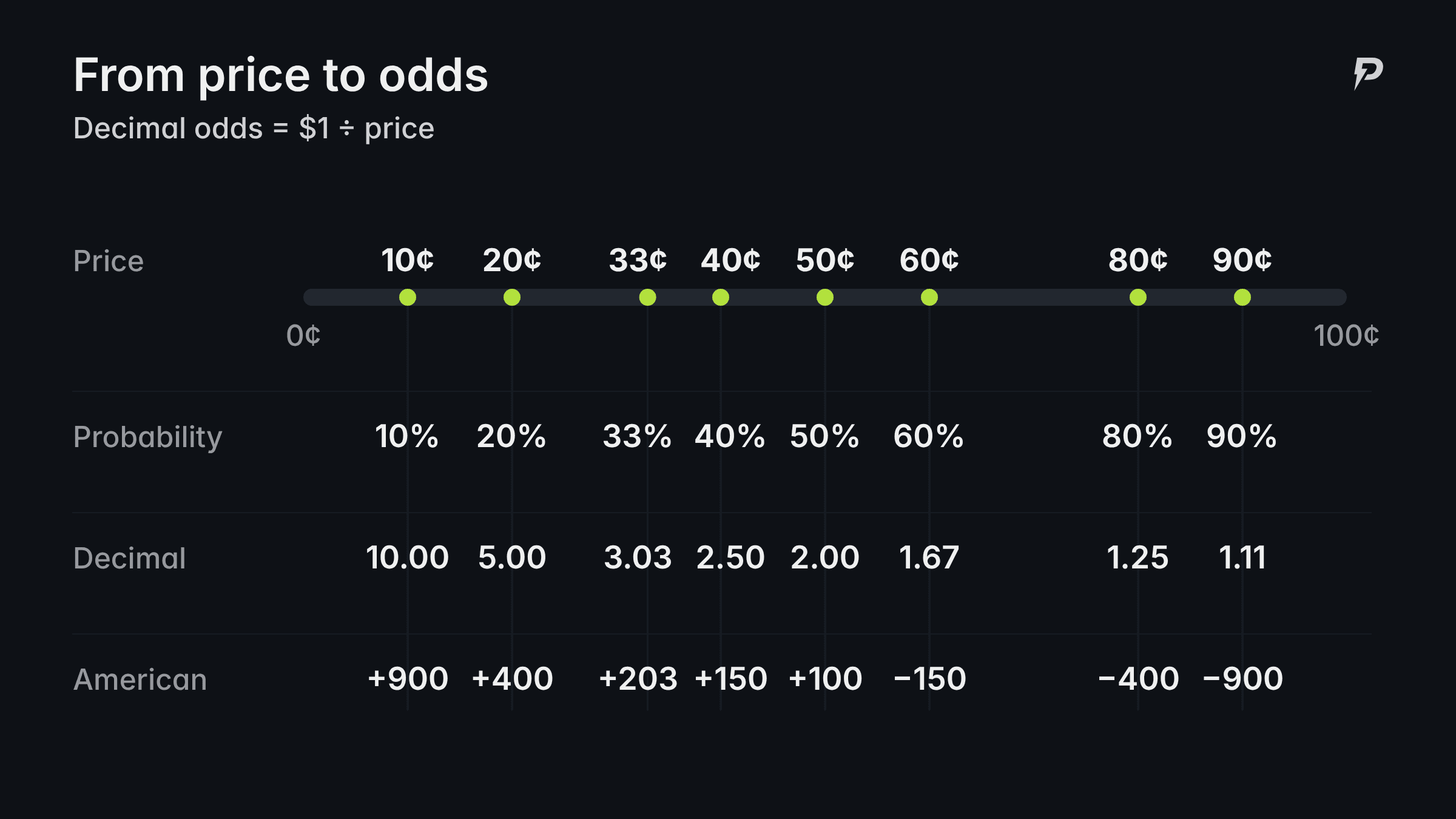
| Price | Implied probability | Decimal | American | Fractional | Profit per $1 staked |
|---|---|---|---|---|---|
| 10¢ | 10% | 10.00 | +900 | 9/1 | $9.00 |
| 20¢ | 20% | 5.00 | +400 | 4/1 | $4.00 |
| 25¢ | 25% | 4.00 | +300 | 3/1 | $3.00 |
| 33¢ | 33% | 3.03 | +203 | about 2/1 | $2.03 |
| 40¢ | 40% | 2.50 | +150 | 3/2 | $1.50 |
| 50¢ | 50% | 2.00 | +100 | 1/1 (evens) | $1.00 |
| 60¢ | 60% | 1.67 | −150 | 2/3 | $0.67 |
| 75¢ | 75% | 1.33 | −300 | 1/3 | $0.33 |
| 80¢ | 80% | 1.25 | −400 | 1/4 | $0.25 |
| 90¢ | 90% | 1.11 | −900 | 1/9 | $0.11 |
Going back from odds to price: decimal 2.50 → 1 / 2.50 = 40¢; American +150 → 100 / 250 = 40¢; American −300 → 300 / 400 = 75¢.
A bookmaker builds its margin into the odds, so its implied probabilities add up to more than 100%. Here YES and NO add up to about 100%, and your cost is the spread plus any fees. More in prediction markets vs sports betting.
How to calculate payout and ROI
For any buy:
- Shares = amount spent / price
- Payout if you win = shares × $1
- Profit if you win = payout − amount spent
- Return if you win = (1 − price) / price
Worked example. You spend $50 on YES at 25¢.
- Shares: $50 / 0.25 = 200
- Payout if YES wins: 200 × $1 = $200
- Profit: $200 − $50 = $150, a 300% return
- If NO wins: you lose the $50
With a market order on Preddy, the 0.5% fee goes on top: $0.25 on a $50 order, so you pay $50.25 in total.
You don't have to wait for resolution. If the price rises from 25¢ to 40¢ and you sell all 200 shares at 40¢, you get $80 back: a $30 profit before fees, locked in whatever happens next.
How to calculate expected value on a trade
If your honest estimate of the probability is p and the price is c, the expected value of one share, before fees, is:
EV per share = p − c
The share pays $1 with probability p, so on average it's worth p. You pay c. The difference is your edge.
Example 1: buying YES. YES is at 30¢, and you think the real chance is 40%.
- EV per share: 0.40 − 0.30 = +10¢
- 500 shares cost $150, with an expected profit of 500 × 10¢ = $50
- That's +33% on the money you put in, on average. On any single trade you either make $350 or lose $150.
Example 2: picking the right side. YES is at 70¢, so NO is about 30¢. You think YES is 80% likely.
- Buy YES: 0.80 − 0.70 = +10¢ per share
- Buy NO: 0.20 − 0.30 = −10¢ per share
Same market, same opinion, opposite results. Always check the side you're buying against your probability for that side.
Example 3: when the edge shrinks. The mid price is 50¢, the best ask is 52¢, and you think the chance is 53%.
- Against the mid, your edge looks like 3¢.
- You can't buy at the mid. You buy at the ask: 0.53 − 0.52 = 1¢.
- A 0.5% market-order fee on 52¢ costs about 0.26¢, so your edge is now about 0.74¢ per share.
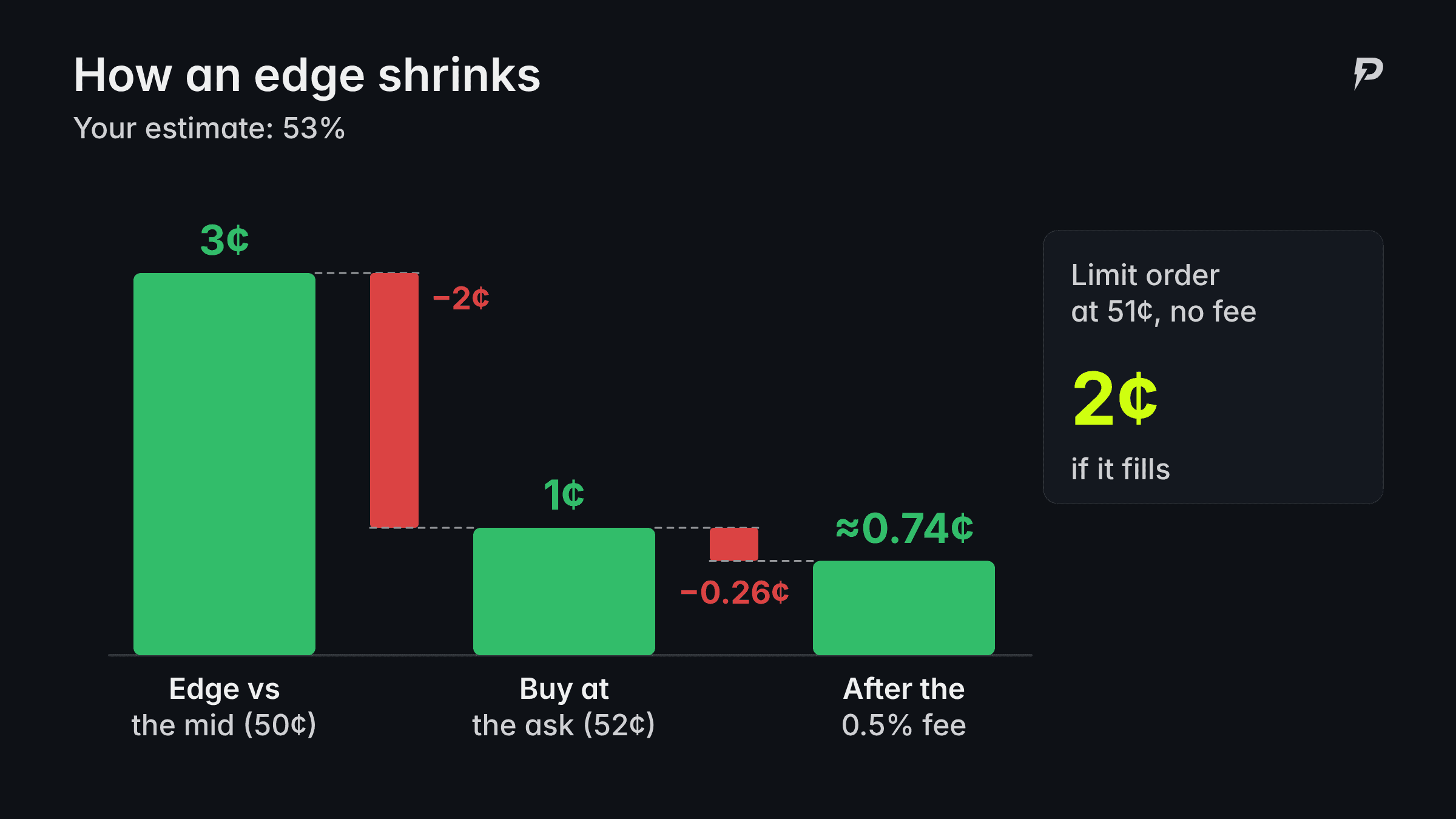
The edge is still positive, but it's tiny, and an estimate off by a single point wipes it out. A limit order at 51¢, which is free on Preddy, would get you 2¢ per share if it fills (market vs limit orders).
A positive EV tells you a trade is worth making. It doesn't tell you how much to put on it. For that, see position sizing and risk.
The market says 30%. Should you agree?
EV is only as good as your p. Most of the time the market's number is better than yours, so the honest default is to agree with it. Some ways to find the exceptions:
- Write your number down before you look at the price. Once you've seen "30%", every estimate drifts toward 30.
- Start from a base rate. How often does this kind of thing happen at all? Then adjust for what's specific to this case.
- Read the rules. Plenty of "mispricings" turn out to be other traders reading the rules more carefully than you.
- Ask what the market knows. If the price just moved 15¢ on heavy volume, someone may know something. Look at who's trading before you bet against it.
- Ask what you know that it doesn't. A real edge is narrow and specific: local knowledge, a faster source, a model of something niche. A hunch isn't one.
- Allow for doubt. If you think 40% but wouldn't be shocked at 30%, your edge is smaller than it looks. Demand more margin when you're less sure.
- Keep score. Record your estimate on every trade. After 50 trades, check whether the things you called 70% happened about 70% of the time. That's the only way to find out whether you're any good.
If your number still differs, you don't have to trade right away. Set a price alert at the level where the trade becomes worth it and let the market come to you.
Prices are probabilities set by other traders, not facts. Nothing here is financial advice, and prediction markets aren't available everywhere. Check your local rules.
Quick recap
- Price in cents ≈ implied probability. A share pays $1 or $0.
- YES + NO ≈ $1. Buying NO at 30¢ is the same bet as selling YES at 70¢.
- Read the mid for probability, the ask for what you'll pay, the bid for what you'll get.
- Spread, fees, long-shot bias, thin books and long lock-ups all pull prices away from the true chance.
- EV per share = your probability − price. Measure it against the price you can actually trade at, after fees.
Ready to put a number on something? Browse live markets and compare your estimate with the price before you trade.
Keep reading
Market vs limit orders
Spread, slippage and how to avoid overpaying when you buy.
Position sizing and risk
How much to put on a trade once you've found an edge.
Multi-outcome markets
Why outcome prices sum to about 100%, and where they don't.
Prediction market glossary
Every term you'll run into, explained in plain words.