Multi-outcome prediction markets explained
How multi-outcome prediction markets work, why the YES prices add up to about 100%, what NO on one candidate really means, and how to spot mispricing.
By Preddy Team
"Who will win the election?" with four candidates looks like one market with four buttons. It isn't. It's four separate YES/NO markets that happen to be shown together. Once you see it that way, a lot of things click: why the prices add up the way they do, what a NO really bets on, and where the occasional mispricing hides.
What is a multi-outcome market?
A multi-outcome market (on Polymarket it's an event with several markets inside it) is a group of binary markets, one per outcome:
- "Will Candidate A win?" YES / NO
- "Will Candidate B win?" YES / NO
- …and so on for every outcome listed.
Each one has its own orderbook, its own price and its own YES and NO shares. When the event resolves, the winner's YES pays $1 and every other YES pays $0. On the losing outcomes, NO pays $1.
That only works when exactly one outcome can win. Most "who will win" groups are built that way. Some groups aren't. "Which of these countries will hold an election this year?" can have several YES winners, and nothing in this post about prices adding up to 100% applies to those. Check the rules before you assume.
Why the YES prices add up to about 100%
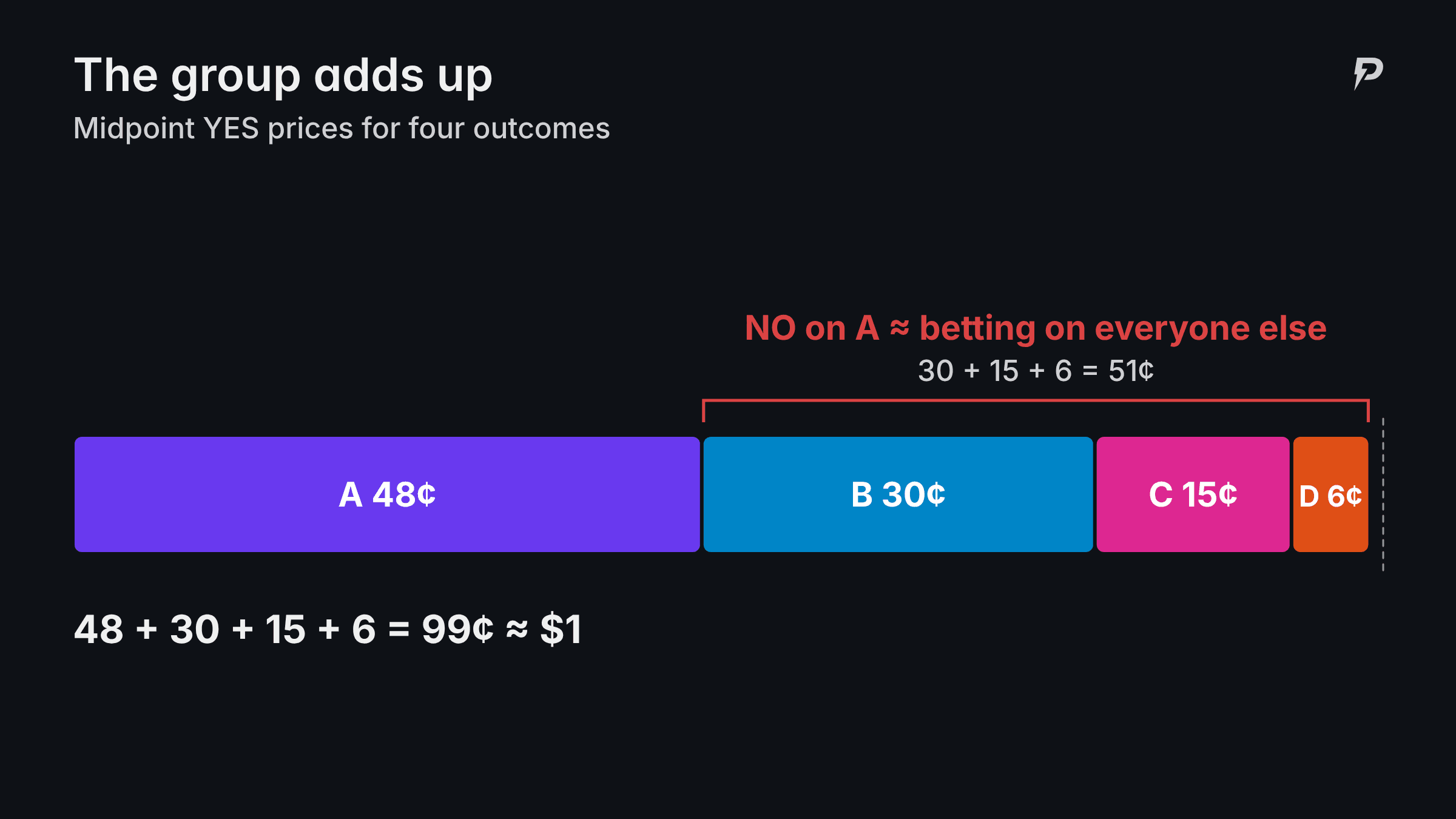
If exactly one outcome wins, buying one YES share of every outcome is guaranteed to pay exactly $1. So the full set should cost about $1 too.
- If the set costs less than $1, you could buy all of it and lock in a profit.
- If the YES bids add up to more than $1, you can do the reverse: sell a full set you hold, or buy NO on every outcome, and lock in a profit the other way.
Traders hunt for both, and that pressure keeps the YES prices near 100% in total. Since a price in cents is also a probability (see prediction market odds and probability), this is the market saying "these chances add up to one," which they have to.
What it means when they add up to 104% or 96%
First, check which prices you're adding. The number shown next to each outcome is often a midpoint or the last trade. What you would actually pay is the ask, and what you'd actually get when selling is the bid.
Sum of asks above 100% is normal. That's the spread. Buying everything at the ask costs a bit more than $1, like the margin built into bookmaker odds. With thin markets and many long shots, the sum of asks can easily reach 104% or more. Nothing to exploit there.
Sum of asks below 100% looks like free money: buy every outcome for 96¢, collect $1. Before you jump, check:
- Depth. The 96¢ total might hold for 30 shares and then disappear. Look at how many shares sit at each ask.
- Fees. Market orders on Preddy carry a 0.5% taker fee (see fees), and some Polymarket markets charge their own fees. A 4¢ edge can shrink fast.
- Execution. You need every leg filled. If one price moves while you're filling the others, you're left holding a normal directional bet. Our guide to market vs limit orders covers slippage.
- Completeness. Is every possible winner listed? If the rules allow the event to resolve with no listed outcome winning, the set doesn't guarantee $1.
- Lockup. You get paid at resolution, which could be months away. 4% locked for a year is a weak return.
A gap like this is a real opportunity sometimes. More often it's thin liquidity or a stale quote.
Betting NO on one outcome means betting on the field
NO on Candidate A pays $1 if A doesn't win, in other words if anyone else wins. So it should cost about the same as buying YES on all the others:
NO on A ≈ 100¢ − YES on A ≈ YES on B + YES on C + YES on D
These two routes rarely cost exactly the same, and comparing them is free. Buying NO is one order instead of three. Buying the others' YES lets you leave out an outcome you think is dead, at the cost of not getting paid if it wins.
How negative-risk markets on Polymarket keep prices consistent
On Polymarket, many multi-outcome markets are set up as negative-risk markets. The core feature, in plain words: one NO share on one outcome can be converted into one YES share on every other outcome in the group.
That makes sense once you look at the payouts. NO on A pays $1 if anyone but A wins. One YES each on B, C and D also pays exactly $1 if anyone but A wins. Same payoff, so the contract lets you swap one for the other. Because traders can always move between the two, the NO price on one outcome can't drift far from the sum of the other YES prices without someone stepping in.
This matters most when you hold NO on more than one outcome. Say you hold NO on A and NO on B in a four-way race. Only one of them can win, so at least one of your NO shares is guaranteed to pay. Converting that pair gives you $1 in cash straight away plus YES on C and D. Your payoff is identical in every scenario, but $1 of it is freed up now instead of sitting until resolution.
On Preddy, multi-outcome markets that support it show a Convert action in the trading panel, so you can do this swap without leaving the market page.

Long shots at 1–3¢: why they're usually overpriced
Scroll to the bottom of a 20-team league market and you'll often see a row of teams at 1–3¢. Add up ten of them at 2¢ and the market is saying they have a 20% combined chance. Often that's far too high.
Why do they stay up there?
- The floor. Most markets trade in 1¢ steps, so 1¢ is the lowest possible price even for an outcome that's closer to 0.1% than 1%.
- Lottery buyers. A 2¢ ticket that pays 50× is fun to buy. Plenty of people buy for the story, not the math.
- Nobody wants the other side. Selling a long shot at 2¢ is the same as buying NO at 98¢: you tie up 98¢ to make 2¢, possibly for months. Few traders bother, so the overpricing persists.
A hypothetical: a team trades at 2¢, and your honest estimate is 0.5%. EV per share = p − c = 0.005 − 0.02 = −1.5¢. That's an expected loss of 75% of what you paid. Long shots do hit, but the price usually pays you less than the risk.
What about "Other" or "Field"?
Some groups include an "Other" or "Field" outcome that covers anyone not named. Read its rules closely: it might pay if a new candidate wins, or the group might add new outcomes as candidates appear. That changes what "Other" actually covers. "Other" can be mispriced in either direction, often because few people trade it.
How to compare one outcome across the group
- Normalize. If the YES midpoints add up to 99%, an outcome at 48¢ implies 48 ÷ 99 ≈ 48.5%. On big fields with a large total, the difference matters more.
- Use bids and asks, not last price. A long shot's last trade might be days old.
- Price the alternatives. For "not A", compare NO on A against the others' YES combined.
- Watch the whole board. If A jumps 10 points, roughly 10 points have to come out of the others. If they haven't moved yet, one side is stale.
Worked example: a four-candidate race
Here's a hypothetical order book snapshot:
| Candidate | YES bid | YES ask | Midpoint |
|---|---|---|---|
| A | 47¢ | 49¢ | 48¢ |
| B | 29¢ | 31¢ | 30¢ |
| C | 14¢ | 16¢ | 15¢ |
| D | 5¢ | 7¢ | 6¢ |
| Total | 95¢ | 103¢ | 99¢ |
What the market thinks. Midpoints add up to 99¢, so A's implied chance is 48 ÷ 99 ≈ 48.5%. Buying the full set at the asks costs 103¢: that's the spread, not an edge.
Betting against A. NO on A costs 100 − 47 = 53¢ (the NO ask mirrors the YES bid). Buying YES on B, C and D at the asks costs 31 + 16 + 7 = 54¢. NO is 1¢ cheaper and one order instead of three.
Betting on a view. You think C's real chance is 25%. Buying YES at 16¢ gives EV = 0.25 − 0.16 = 9¢ per share. 100 shares cost $16, and the 0.5% taker fee on a market order adds $0.08. Expected profit is about $8.92. Use a limit order at 16¢ and there's no Preddy fee at all.
Spotting a gap. Ten minutes later, news moves the board and the asks are now 44¢, 31¢, 15¢ and 6¢. That totals 96¢. One full set costs 96¢ and pays $1 for sure: 4¢ profit, about 4.2%, before fees. The 0.5% taker fee on 96¢ is about 0.48¢, so roughly 3.5¢ net. But if only 50 shares sit at D's 6¢ ask, your total profit is capped at about 50 × 3.5¢ ≈ $1.76, and it arrives only when the event resolves.
That last part is the honest summary of multi-outcome mispricing: real, usually small, and gone fast.
Bottom line
Treat every multi-outcome market as a set of linked YES/NO markets. Add up the asks, not the headline numbers. Price "not A" both ways. Be sceptical of long shots. If you want to put this into practice, browse multi-outcome markets on Preddy and check the asks yourself.